
What Is a TEU? Container Capacity Explained
One 20 ft container counts as 1 TEU; one 40 ft container counts as 2 TEU. Follow the examples to separate box count, carrying capacity and usable space.
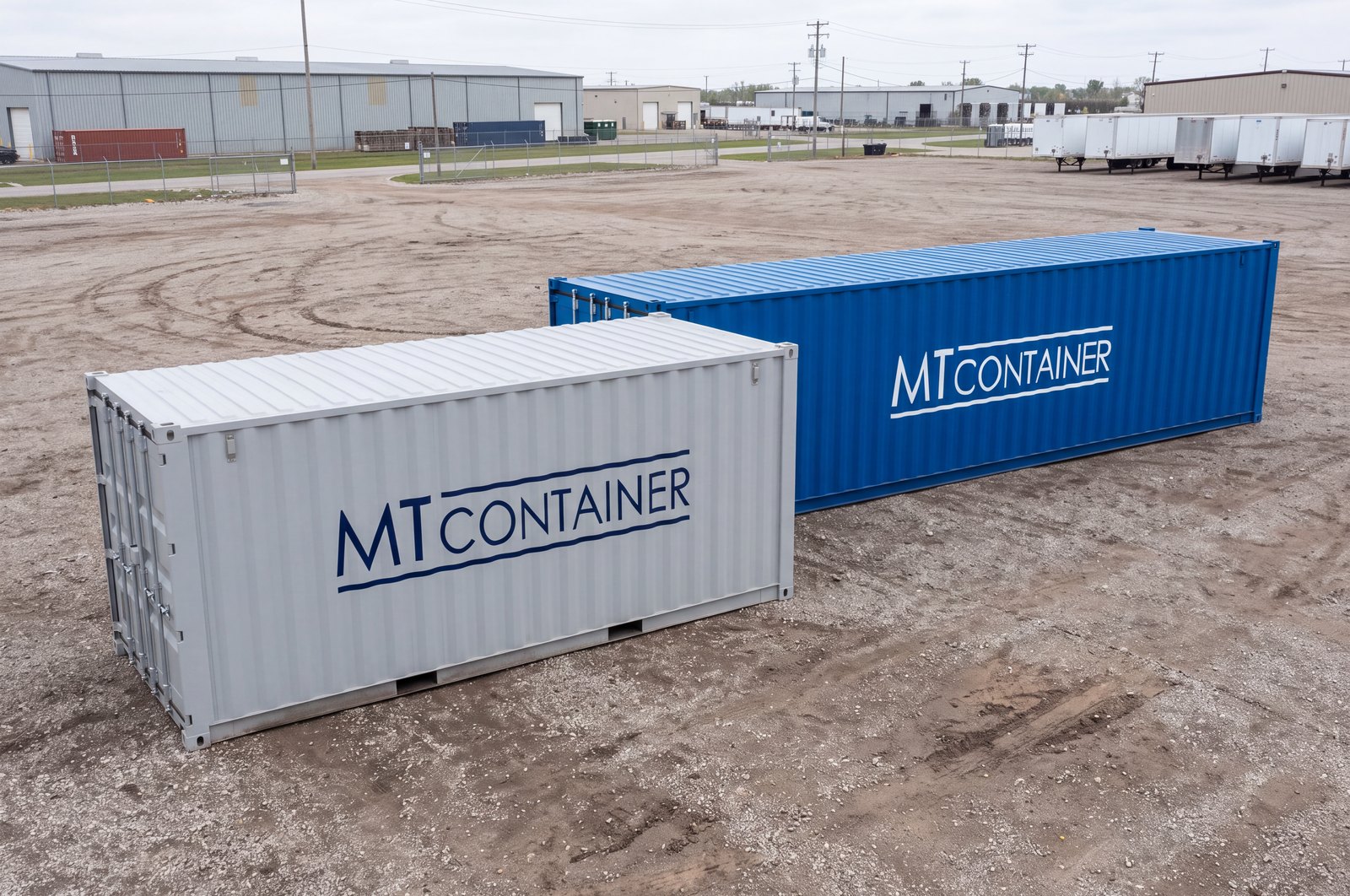
Updated November 2026 · Container capacity explained
What Is a TEU in Shipping?
What is a TEU? A twenty-foot equivalent unit is a counting unit based on a 20 ft shipping container. One 20 ft container counts as 1 TEU; one 40 ft container counts as 2 TEU. It puts different container sizes on a shared scale for transport statistics and capacity comparisons. The Eurostat glossary defines it as “a unit of volume used in maritime and rail transport statistics, equivalent to a 20-foot ISO container.” In daily use it works as a count, which is why the space inside the box can differ, as shown below.
“TEU container” is not a container type. The 20 ft container is the reference size for the unit. Keep the unit and the equipment separate: specify the actual container size and type when ordering, then use TEU to summarize the count.
TEU vs. FEU: The Quick Comparison
FEU means forty-foot equivalent unit. 1 FEU = 2 TEU. Maersk also uses FFE for the same unit. Its FEU and FFE explanation gives that relationship.
| Container mix | Boxes | TEU | FEU equivalent |
|---|---|---|---|
| One 20 ft container | 1 | 1 | 0.5 |
| One 40 ft container | 1 | 2 | 1 |
| Two 20 ft containers | 2 | 2 | 1 |
| One 40 ft high cube | 1 | 2 | 1 |
High cube means a taller container. Its TEU count usually matches a standard-height container of the same length: a 40 ft high cube counts as 2 TEU. Freightos explains the high cube convention. The FEU equivalents above are our arithmetic conversions; two smaller boxes remain two separate containers.
How to Calculate TEU
For a mix of 20 ft and 40 ft containers, use TEU = number of 20 ft containers + 2 × number of 40 ft containers. Count standard and high cube 40 ft units together.
Worked example: 3 × 20 ft containers plus 2 × 40 ft containers gives 3 × 1 + 2 × 2 = 7 TEU. The physical count is 3 + 2 = 5 containers. Expressed in FEU equivalents, 7 ÷ 2 = 3.5 FEU. These numbers only show the method. They do not describe a real shipment.
A second example: 6 × 40 ft high cubes gives 6 × 2 = 12 TEU, or 6 FEU. Write both the box count and the TEU total in your worksheet so the reader can see the equipment mix.
An example from our own work: one 10 ft and three 20 ft containers were set up in 2024 as lockable storage for tools and material at a construction site in Hamburg, Germany. For a job like this, the useful description is the box list. The three 20 ft units are 3 TEU by the rule above; a TEU total alone would hide the smaller fourth box.
We list the 10 ft box by size and do not assign it a TEU value on this page. For that size, see our 10 ft shipping container page.
Ship Capacity and Port Throughput Mean Different Things
A ship’s nominal TEU capacity is its stated number of container spaces, called slots, counted in 20 ft units. Weight is a separate limit: the slot count alone does not tell you how many heavily loaded containers fit on a voyage. “Propulsion trends in container vessels,” section “Definitions”, distinguishes maximum TEU capacity from the ship’s weight-carrying capacity.
For an illustrative 1,000 TEU figure, the arithmetic equivalent is 1,000 ÷ 2 = 500 FEU. This converts the unit; the vessel’s layout and loading limits still determine the actual mix carried.
Port throughput means containers handled over a stated period. The Port of Los Angeles’s 2025 statistics report 10,239,318.40 TEU, about 10.24 million, for the calendar year, with loaded and empty imports and exports included. That is annual activity, rather than the number of boxes standing in the port at once.
Read a port’s capacity figure alongside its time basis and definition: annual handling capacity and storage capacity answer different questions. When comparing reported throughput, align the reporting period and check whether empty containers are included. Keep capacity, actual throughput and physical box count in separate columns.
Why TEU Is Not an Exact Measure of Usable Space
Equal TEU counts can describe different amounts of interior space. Using Hapag-Lloyd’s published capacities, our conversions put its example 40 ft standard container at about 2,391 cu ft (67.7 m³) and its 40 ft high cube at about 2,695 cu ft (76.3 m³). Both count as 2 TEU.
Our conversion uses 35.3147 cu ft per m³, rounded to whole cubic feet. Hapag-Lloyd’s own pages print 2,390 and 2,694 cu ft, one cubic foot less in each case. The high cube example holds about 304 cu ft (8.6 m³) more, from 76.3 − 67.7 = 8.6 m³. That is 12.7% more interior volume than the standard example. These are fleet examples; confirm the offered unit’s specifications.
For buying or packing, request the interior dimensions, clear door opening and payload, meaning the permitted cargo weight. Compare them with your items and packing layout. A TEU total alone leaves those checks unanswered.
For unusual lengths, use the reporting organization’s conversion rule. Eurostat’s maritime statistics manual, section 3.5.3, assigns containers longer than 40 ft, such as 45 ft units, a factor of 2.25 TEU for its reporting system. Treat that as a defined statistical convention rather than a universal length-divided-by-20 formula.
Questions About TEU and FEU
What is a TEU container?
A 20 ft container is the reference for 1 TEU. TEU itself is the unit used to count capacity, while the container is the physical equipment.
How many TEU are in a 40 ft container?
Two TEU, equivalent to 1 FEU. A 40 ft high cube is usually counted the same way.
What is TEU in weight?
TEU is not a unit of weight. It counts container capacity in 20 ft equivalents. For cargo weight, use the specific container’s payload rating; for a vessel, use its loading limits.
Can you convert cubic meters (CBM) directly to TEU?
No. The standard and high cube examples above have different interior volumes at the same TEU count. Select equipment using the cargo dimensions and weight, then calculate TEU from that equipment mix.
Does 2 TEU mean two containers?
It can mean two 20 ft containers or one 40 ft container. State the sizes alongside the TEU figure to make the physical count clear.
Ask MT About the Container You Need
MT Container has been trading containers from Hamburg, Germany, since 2008. Our team responds in English.
For a container inquiry, send the number of containers, preferred size, intended use and destination ZIP code. For US buyers, new (one trip) and used 20 ft, 40 ft and 40 ft high cube containers are sourced through our US partner network, subject to availability. Offers are priced in USD.
Explore our container options, container leasing page or reefer container page for the equipment and service you need.
Sources and Scope
Sources checked 2026-11-26. Definitions, carrier examples and port statistics are linked beside the relevant statements. Worked totals and volume conversions are our calculations. The drawings explain counting and interior-space differences; they are separate from a vessel loading plan.