
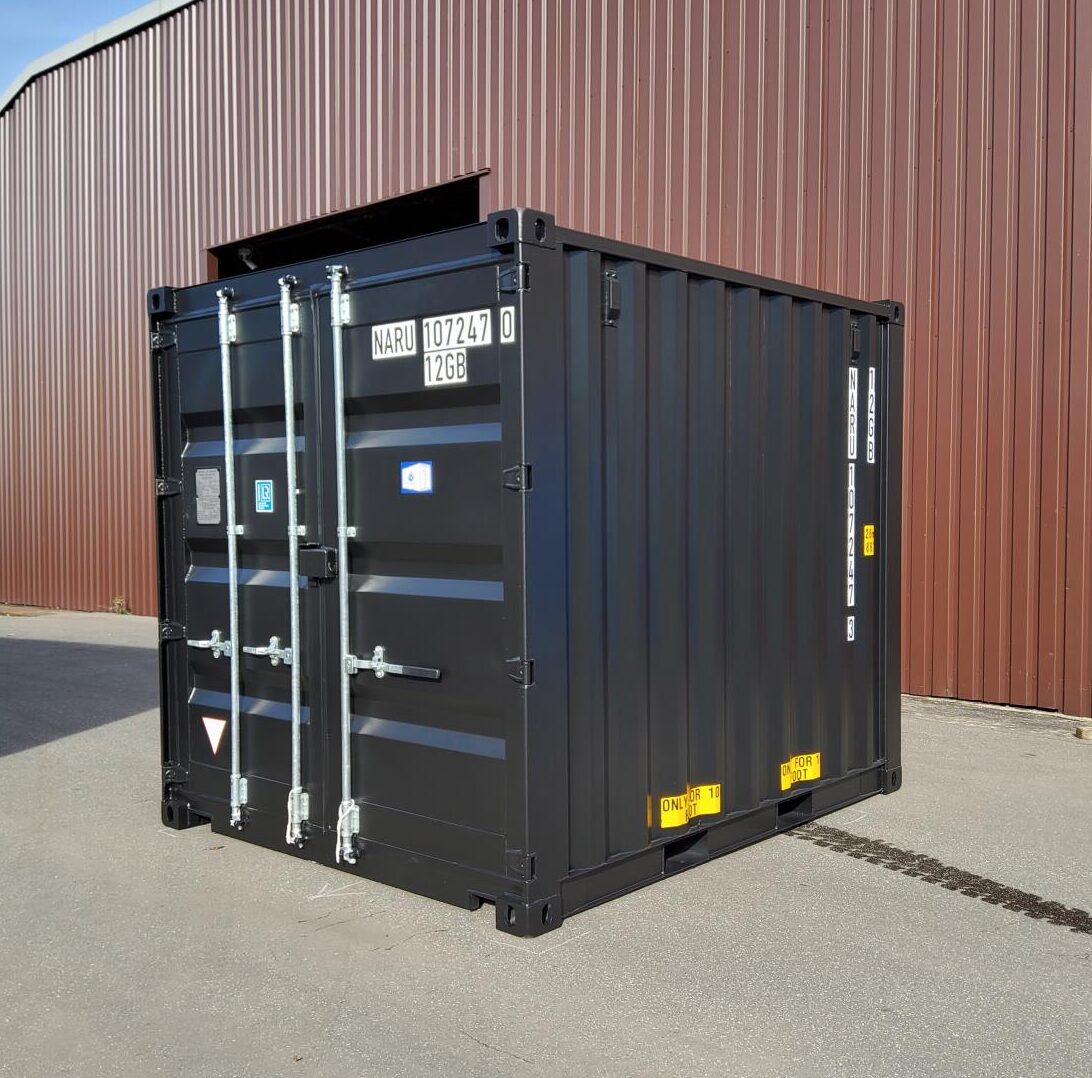
10 ft Shipping Containers: The Short Version
Quick answer
A 10 ft shipping container is 9 ft 9.8 in long, 8 ft wide and 8 ft 6 in high on the outside and holds about 562 cu ft. A typical steel unit weighs about 2,870 lb (1,300 kg) empty and is rated for a gross weight of 22,400 lb (10,160 kg). It is as wide and as high as a 20 ft container and just under half as long. Most 10 ft containers are used for storage, and not every 10 ft box on the market is approved for transport.
MT Container has been trading containers from Hamburg, Germany, since 2008. This page gives the dimensions and weights of 10 ft containers in feet and pounds, explains when a 10 ft box counts as a shipping container, shows what fits inside and compares it with a 20 ft container. At the end, you will find a buying checklist and details on how to get a quote in the US.
10 ft containers at a glance
- Also called
- 10ft shipping container, 10 foot storage container, 10 ft Conex box
- Outside (L × W × H)
- 9 ft 9.8 in × 8 ft × 8 ft 6 in (2,991 × 2,438 × 2,591 mm)
- Inside (L × W × H)
- about 9 ft 3.5 in × 7 ft 8.5 in × 7 ft 10.1 in (2,831 × 2,350 × 2,390 mm)
- Floor area and volume
- about 71.6 sq ft and 562 cu ft (6.65 m² and 15.9 m³)
- Empty weight
- about 2,870 lb (1,300 kg), depending on the build
- Maximum gross weight
- 22,400 lb (10,160 kg) on the reference unit; the plate on the unit itself is what counts
- Pallets on the floor
- 4 US pallets (48 × 40 in) or 5 Euro pallets
- High cube
- 9 ft 6 in (2,896 mm) high outside, 632 cu ft (17.9 m³)
- For US customers
- new and used units through our US partner network, subject to availability
10 ft Shipping Container Dimensions
A 10 ft container has the same width and height as a standard 20 ft or 40 ft container. Only the length differs. The table shows a standard-height unit and a high cube. The figures come from the data sheet of the Australian container company SCF, which publishes both versions with their weights. Other builds differ, as the examples below the table show.
The door opening matters as much as the inside dimensions, because everything you store has to pass through it. On a standard-height unit, it is about 7 ft 8 in (2,338 mm) wide and 7 ft 5.8 in (2,280 mm) high. These two figures come from our own size table.
| 10 ft standard | 10 ft high cube | |
|---|---|---|
| Outside length | 9 ft 9.8 in (2,991 mm) | 9 ft 9.8 in (2,991 mm) |
| Outside width | 8 ft (2,438 mm) | 8 ft (2,438 mm) |
| Outside height | 8 ft 6 in (2,591 mm) | 9 ft 6 in (2,896 mm) |
| Inside length | 9 ft 3.5 in (2,831 mm) | 9 ft 3.8 in (2,840 mm) |
| Inside width | 7 ft 8.5 in (2,350 mm) | 7 ft 8.5 in (2,350 mm) |
| Inside height | 7 ft 10.1 in (2,390 mm) | 8 ft 10.2 in (2,698 mm) |
| Footprint | 78.5 sq ft (7.29 m²) | 78.5 sq ft (7.29 m²) |
| Volume | 562 cu ft (15.9 m³) | 632 cu ft (17.9 m³) |
Feet, inches and pounds are our own conversion from the metric values, rounded to 0.1 in and 10 lb. The footprint is outside length times outside width.
Published dimensions for 10 ft containers vary by manufacturer and model. Two examples: the UK supplier Algeco lists a 10 ft unit that is a full 10 ft (3,048 mm) long on the outside and 9 ft 2.6 in (2,808 mm) long inside. A US dealer lists a new 10 ft unit with an inside length of 9 ft 2.3 in (2,802 mm) and an inside width of 7 ft 7.7 in (2,330 mm), which are the minimum inside dimensions the ISO standard sets for this size. If shelving or equipment has to fit to the inch, measure the unit or ask for its data sheet first.
How Much Does a 10 ft Shipping Container Weigh?
A steel 10 ft container weighs about 2,870 lb (1,300 kg) empty, and a high cube about 2,980 lb (1,350 kg). These are the tare weights on the SCF data sheet. Tare is the empty weight, payload is the maximum cargo weight the unit may carry, and the maximum gross weight is the two added together.
| 10 ft standard | 10 ft high cube | |
|---|---|---|
| Empty weight (tare) | 2,870 lb (1,300 kg) | 2,980 lb (1,350 kg) |
| Maximum payload | 19,530 lb (8,860 kg) | 22,050 lb (10,000 kg) |
| Maximum gross weight | 22,400 lb (10,160 kg) | 25,020 lb (11,350 kg) |
Pounds are rounded line by line, so tare plus payload can differ from the gross weight by 10 lb.
The ISO standard for container sizes rates the 10 ft size at a maximum gross weight of 22,400 lb (10,160 kg). Individual units can be rated lower or higher. Algeco lists its 10 ft unit at 3,360 lb (1,523 kg) empty and 22,270 lb (10,100 kg) gross. A US dealer lists a new 10 ft unit with a net weight of only 1,910 lb (867 kg) and a maximum gross weight of 14,330 lb (6,501 kg).
Read the weights on the unit
The figures that count are the ones on the container itself. The maximum gross weight must be marked on the safety approval plate (CSC plate) of an approved container, and most containers also show the tare and the payload. Use those figures when you plan a lift, a truck or a load.
Is a 10 ft Container a Real Shipping Container?
Yes, 10 ft is an official container size. The ISO standard for container sizes lists it as size 1D, with a length of 9 ft 9.8 in (2,991 mm) and a width of 8 ft (2,438 mm). In the four-character size and type code on a container, a 1 as the first character stands for this length, and a 2 as the second character for a height of 8 ft 6 in.
The standard itself defines the 10 ft size with a height of 8 ft (2,438 mm). In practice, 10 ft containers are more often built 8 ft 6 in (2,591 mm) high, so they match 20 ft and 40 ft containers of standard height.
Whether a particular 10 ft box may travel as a shipping container depends on its approval, not on its size. Containers in international transport must be safety-approved under the International Convention for Safe Containers (CSC) and carry a safety approval plate, the CSC plate. US law applies the convention to containers that have corner fittings and a footprint of at least 150 sq ft, or of at least 75 sq ft if the container has top corner fittings (49 CFR 450.3). A 10 ft container has a footprint of 78.5 sq ft. If it is built with top corner fittings, the reinforced corners used for lifting and securing, it falls within this definition.
An approved container has to be examined regularly. Under 49 CFR 452.1, the first examination is due no later than five years after manufacture, and each later one within 30 months. The alternative is an approved continuous examination program, which is marked on the container with the letters ACEP.
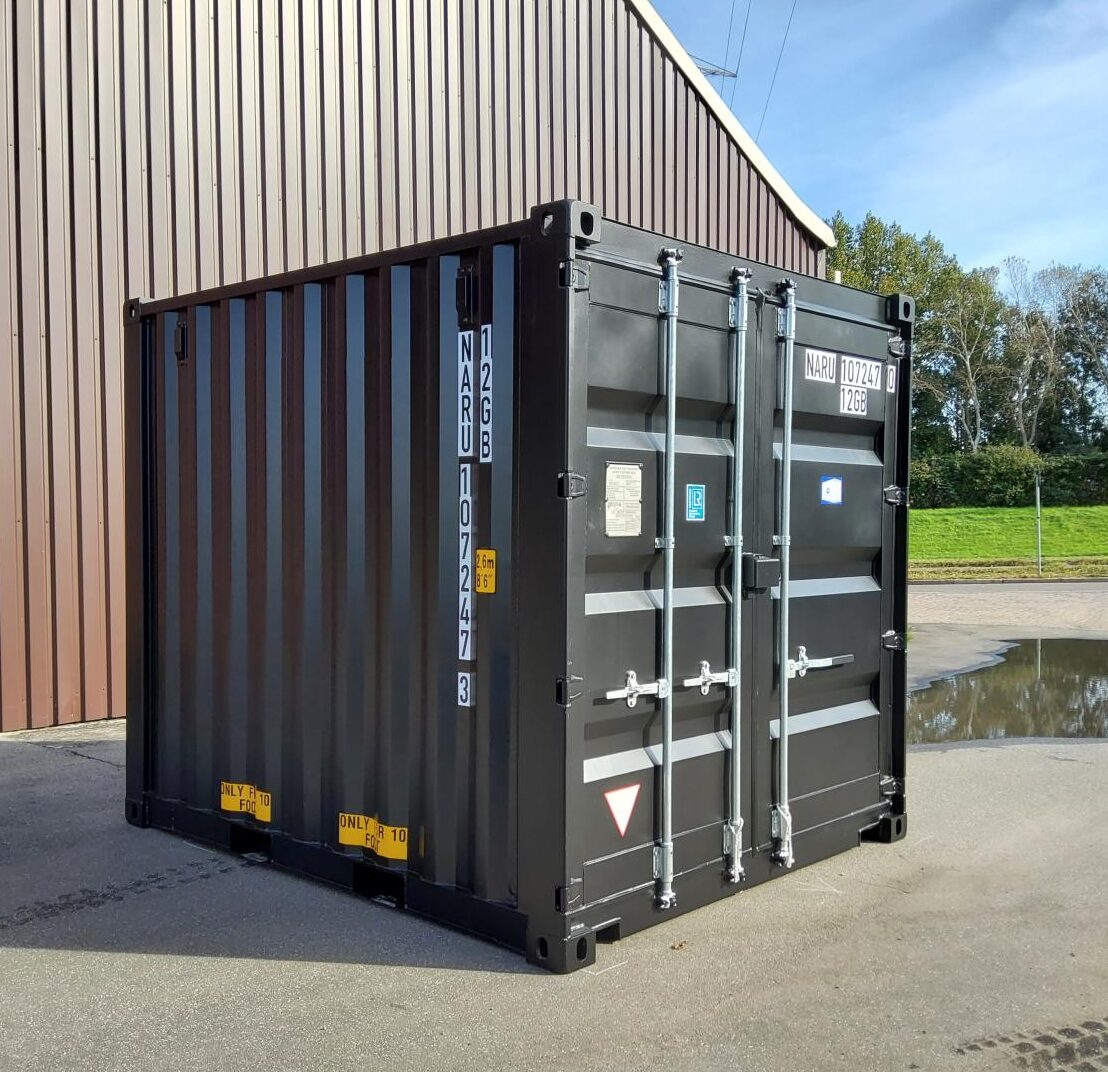
Three kinds of 10 ft boxes on the market
- Approved for transport
- units with a valid CSC plate. They can be shipped.
- Storage-only boxes
- units sold without a valid CSC plate. One US dealer, for example, sells new 10 ft units for storage and offers the CSC survey at additional cost.
- Conversions
- units cut down from a longer container, for example a 20 ft unit. Ask whether the unit still carries a valid CSC plate after the conversion.
For storage on your own site, all three can do the job. If the unit is to travel by sea, ask for a valid CSC plate before you buy, and ask the carrier or freight forwarder how they handle 10 ft units. The container lengths in the ISO standard are chosen so that shorter containers can be combined: two 10 ft containers coupled end to end with a 3 in (76 mm) gap are exactly as long as one 20 ft container, 19 ft 10.5 in (6,058 mm).
Two 10 ft containers
Coupled end to end with a 3 in gap.One 20 ft container
The same overall length: 19 ft 10.5 in.What Fits in a 10 ft Container?
A standard-height 10 ft container offers about 71.6 sq ft of floor area and 562 cu ft of space. Typical contents are tools, building materials, equipment, spare parts, files and seasonal stock. Modified 10 ft containers also serve as equipment enclosures, for example for telecom or monitoring equipment, and one unit takes up only about 80 sq ft on a warehouse dock.
4 US pallets (48 × 40 in)
Two rows of two, each pallet with its 48 in side along the container.5 Euro pallets (1,200 × 800 mm)
Three crosswise in one row, two lengthwise in the other.Pallets in one layer on the floor
- US pallets (48 × 40 in)
- 4. Two rows of two pallets, each with its 48 in side along the length of the container, take up 96 in of the 111.5 in inside length and 80 in of the 92.5 in inside width.
- Euro pallets (47.2 × 31.5 in, 1,200 × 800 mm)
- 5. Three pallets stand crosswise in one row and two lengthwise in the other. Both rows are 94.5 in (2,400 mm) long, and together they are 78.7 in (2,000 mm) wide. The inside is 111.5 in long and 92.5 in wide.
Both counts are our own calculation from the inside dimensions in the table, without overhang. Pallets also have to pass through the door opening, which is about 92 in wide.
One example from our own business: on a renovation site in Hamburg, one 10 ft container and three 20 ft containers have been in use since 2024 as lockable storage for tools and materials.
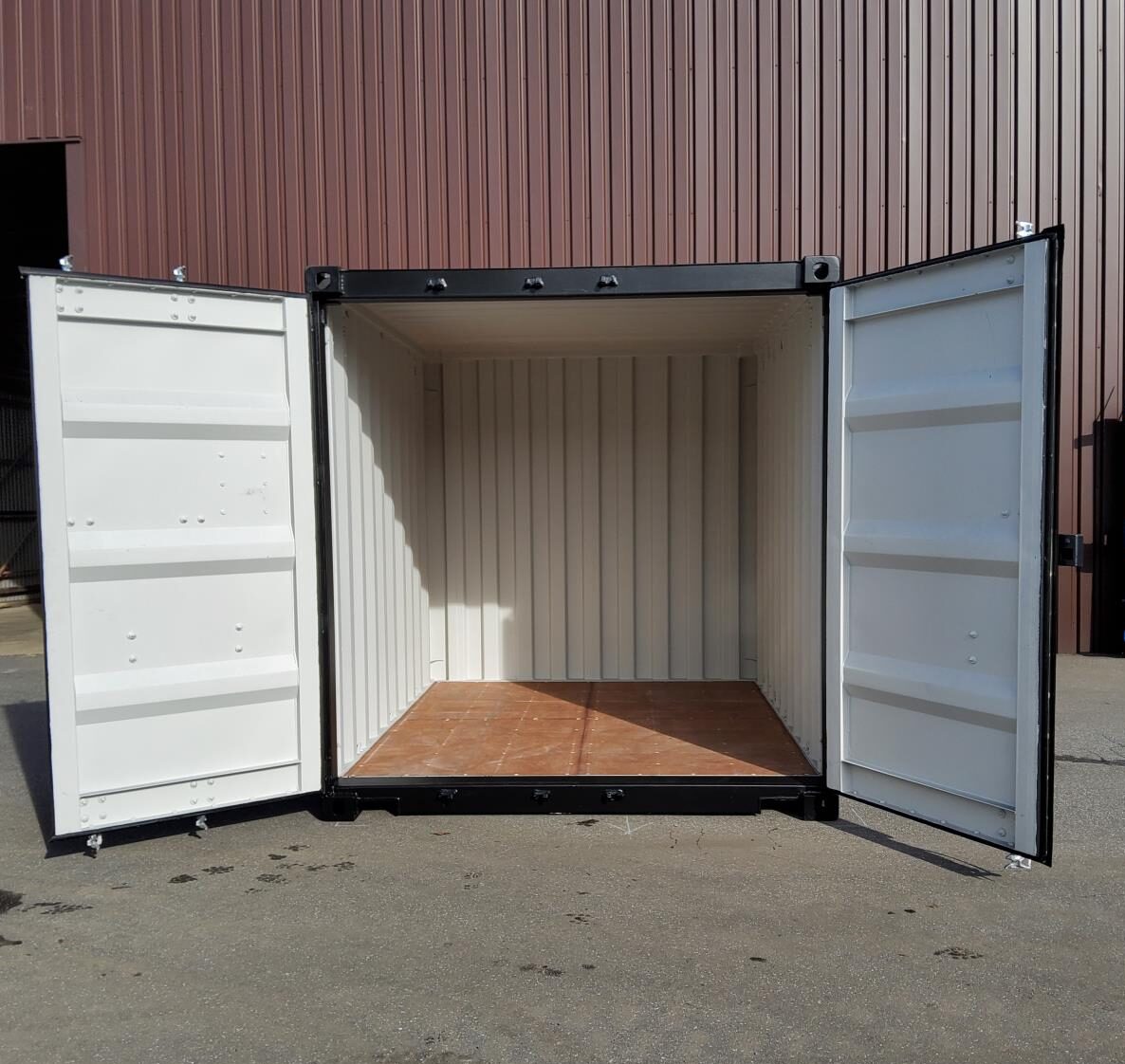
10 ft High Cube, Double Door, Open Side and Reefer Versions
A 10 ft high cube is 9 ft 6 in (2,896 mm) high on the outside, one foot more than a standard-height unit. On the SCF data sheet, it is 8 ft 10.2 in (2,698 mm) high inside and holds 632 cu ft (17.9 m³), about 70 cu ft more than the standard version.
Double door containers have doors at both ends. Open side containers also have doors along one long side, so you can reach goods without unloading from the front. For customers in the US, we source both versions through our US partner network on request, subject to availability.
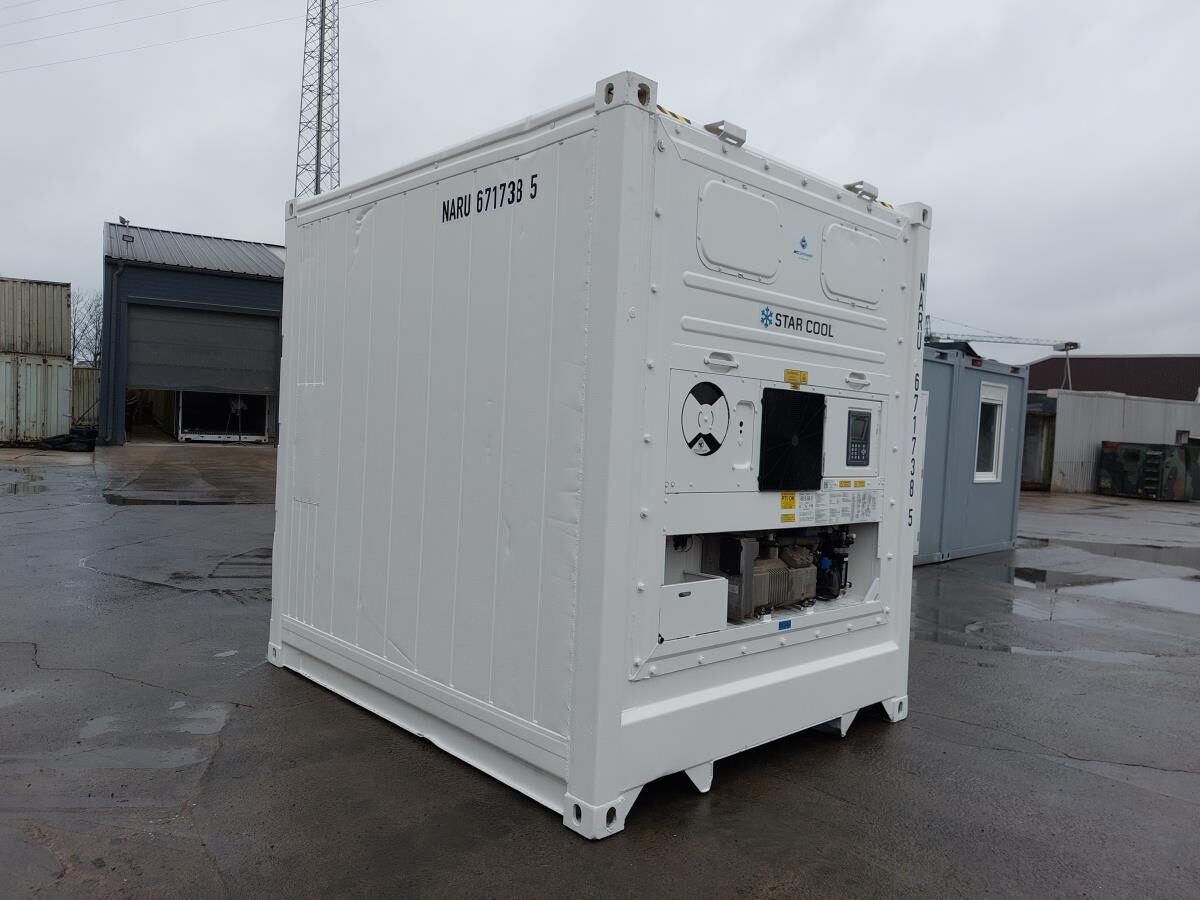
10 ft refrigerated containers exist as well. Some are conversions: a longer reefer is cut down and keeps its refrigeration unit. Ask whether a converted unit still carries a valid CSC plate. Sizes and technology are explained in our reefer container guide, and buying is covered on our page about reefer containers for sale. If you need a 10 ft reefer, ask our team whether one is available.
10 ft vs. 20 ft Container: Which Size Do You Need?
A 20 ft container has about twice the footprint and a little more than twice the volume of a 10 ft container. The inside length, volume and weights of the 20 ft container come from the Transport Information Service of the German insurers, which quotes data from the shipping line Hapag-Lloyd. Its outside length is the ISO length, and the footprint is our own calculation.
| 10 ft container | 20 ft container | |
|---|---|---|
| Outside length | 9 ft 9.8 in (2,991 mm) | 19 ft 10.5 in (6,058 mm) |
| Footprint | 78.5 sq ft (7.29 m²) | 159 sq ft (14.77 m²) |
| Inside length | 9 ft 3.5 in (2,831 mm) | 19 ft 4.1 in (5,895 mm) |
| Volume | 562 cu ft (15.9 m³) | 1,172 cu ft (33.2 m³) |
| Empty weight | about 2,870 lb (1,300 kg) | about 4,960 lb (2,250 kg) |
| Maximum gross weight | 22,400 lb (10,160 kg) | up to 67,200 lb (30,480 kg) |
| US pallets on the floor | 4 | 9 in two straight rows, 10 in a mixed layout |
| Euro pallets on the floor | 5 | 11 |
| Availability | fewer units in circulation, so finding the right unit can take longer | a standard size of the shipping lines |
The pallet counts for the 20 ft container are our own calculation for one layer without overhang, from an inside length of 232.1 in and an inside width of 92.5 in. Ten US pallets fit in a mixed layout: one row starts with two pallets lengthwise and continues with three crosswise, and the other row starts with two crosswise and continues with three lengthwise. This layout is 224 in long and 88 in wide, which leaves about 8 in of length and 4.5 in of width to spare in the reference container. Check the actual container, pallet and load dimensions before you plan ten spaces.
A 10 ft container is the better choice when space is tight, when one crew or one trade needs its own lockable storage, or when the unit has to stand inside a building. A 20 ft container is the better choice when you need more than four US pallet spaces, when you store items longer than about 9 ft, or when the unit will be shipped by sea later.
Placing a 10 ft Container on Your Site
A container needs firm, level ground with drainage and supports suited to its design and load. For a simple, unmodified ISO storage container, corner supports may be sufficient. If the manufacturer or seller provides a support plan for the specific unit, follow it.
A continuous concrete slab is not always necessary. Compacted gravel with suitable load-spreading pads can be an option on checked ground. Heavily loaded or modified containers may need additional support points. Keep all specified supports level; settlement or twisting can make the doors hard to open and close.
Before delivery, check five things: the access road, the width and height of gates, the room the truck needs to maneuver, the ground where the container will stand, and obstacles overhead such as trees or power lines. Ask how the container will be unloaded and how much room that takes. Half the reference door opening is about 3 ft 10 in, which gives a rough clearance estimate. Check the actual door-leaf dimensions and leave enough clear space for both doors to open fully.
Some 10 ft containers have forklift pockets; the SCF units, for example, do. According to the Transport Information Service, forklift pockets are meant for handling empty containers, and a packed container must not be lifted this way unless that is specifically permitted. Whether you need a permit to place a container depends on local zoning rules, so check with your city or county before you order.
10 ft Shipping Containers for Sale in the US: Checklist and Price Factors
For customers in the US, we source 10 ft containers through our US partner network: new (one-trip) and used, with pickup or delivery in the US, priced in USD and subject to availability. One-trip means the unit is new and has been shipped once, from the factory to the country where it is sold. Fewer 10 ft units are in circulation than 20 ft or 40 ft units, so let us know early what you need.
What to check before you buy
- Storage or transport. Decide first whether the unit will ever be shipped. If so, it needs a valid CSC plate with the date of the next examination or the ACEP marking.
- Weights on the unit. Read the maximum gross weight and the tare on the plate and in the markings on the unit, and compare them with what you plan to load.
- Dimensions. Ask for the data sheet of the unit. If shelving, pallets or equipment have to fit, check the inside length and the door opening.
- Origin. Ask whether the unit was built as a 10 ft container or cut down from a longer one.
- Doors. Open and close both doors. The locking bars should move freely and the door gaskets should be complete.
- Roof and walls. Seen from inside with the doors closed, no daylight should come through the roof or the walls. Look for dents in the roof where water can stand.
- Floor. Walk the floor. It should be firm, dry and free of strong odors.
- Condition in writing. For a used unit, ask for the condition grade of that specific unit (for example cargo worthy or wind and water tight) in writing and for photos of it.
The price of a 10 ft container depends on six things: whether the unit is new or used, whether it is approved for transport or sold for storage only, standard height or high cube, the door version (double door or open side), your location, and the delivery distance. We do not publish prices on this page. Quotes for US customers are in USD.
10 ft Shipping Container FAQ
Are there 10 ft shipping containers?
Yes. 10 ft is an official size in the ISO standard for container sizes, where it is listed as size 1D. Most 10 ft containers are used for storage. A 10 ft unit can be shipped if it carries a valid CSC plate.
How big is a 10 ft shipping container?
On the outside, a 10 ft shipping container is 9 ft 9.8 in (2,991 mm) long, 8 ft (2,438 mm) wide and 8 ft 6 in (2,591 mm) high. Inside, the reference unit on this page is 9 ft 3.5 in (2,831 mm) long, 7 ft 8.5 in (2,350 mm) wide and 7 ft 10.1 in (2,390 mm) high, which gives 562 cu ft (15.9 m³).
How much does a 10 ft shipping container weigh?
A typical steel 10 ft container weighs about 2,870 lb (1,300 kg) empty. Published figures for individual units range from 1,910 lb (867 kg) to 3,360 lb (1,523 kg). The tare of a specific unit is marked on the container.
Can you ship a 10 ft container?
Yes, if it has a valid CSC plate and the carrier accepts the size. Two 10 ft containers coupled end to end are as long as one 20 ft container. Ask your carrier or freight forwarder before you book.
How many pallets fit in a 10 ft container?
In one layer on the floor, a 10 ft container takes 4 US pallets (48 × 40 in) or 5 Euro pallets (47.2 × 31.5 in, 1,200 × 800 mm). Both counts are our calculation from the inside dimensions, without overhang.
Do you need a concrete slab for a 10 ft container?
Not necessarily. The ground must be firm, level and drained. Corner supports may be sufficient for a simple, unmodified ISO storage container. If there is a manufacturer’s support plan for the unit, follow it. Heavily loaded or modified units may need additional support points.
How much does a 10 ft shipping container cost?
That depends on whether the unit is new or used, approved for transport or sold for storage only, standard height or high cube, as well as on the door version, your location and the delivery distance. We do not publish prices on this page. Quotes for US customers are in USD.
Can I buy a 10 ft container from MT Container in the US?
Yes. For customers in the US, we source new and used 10 ft containers through our US partner network, with pickup or delivery in the US, priced in USD and subject to availability.
Sources
Retrieved in November 2026. Sizes and ratings: ISO 668 as summarized in the sources below; the standard itself is sold by ISO.
Show all 13 sources
- Wikipedia: ISO 668 (table of container sizes, size 1D, minimum inside dimensions, maximum gross weight)
- Wikipedia: Intermodal container (height of 10 ft containers in practice)
- GDV Container Handbook, section 3.2 (container lengths, combining containers, markings)
- Bureau International des Containers: Size and type codes
- 49 CFR 450.3 (definition of a container); 49 CFR Part 452 (examination of containers)
- International Maritime Organization: International Convention for Safe Containers (CSC)
- SCF: 10ft shipping container fact sheet (PDF)
- Algeco: 10ft shipping container specification sheet (PDF)
- Transport Information Service (GDV): Standard containers (20 ft data from Hapag-Lloyd, door versions, forklift pockets)
- CHS Container Group USA: product page for new 10 ft shipping containers (dimensions, weights, CSC survey)
- Falcon Structures: 10-foot shipping container dimensions and uses (availability, conversions)
- Wikipedia: Pallet (48 × 40 in pallet); Wikipedia: EUR-pallet (1,200 × 800 mm)
- MT Container: own size table (door opening), own guidance on foundations and delivery sites, and own calculations
Values on the plate and in the data sheet of a specific unit take precedence over the typical values on this page.
Need a 10 ft container in the US?
Tell us the height you need, whether you want new or used, the door version, the quantity and your ZIP code. Our team responds in English: contact our team.
MT Container GmbH, Hamburg, Germany. Trading containers since 2008.