

Shipping Container Leasing: The Short Version
Quick answer
Leasing a shipping container means you use it for an agreed term and pay a lease rate instead of buying it. MT Container leases standard, refrigerated and special containers in three ways: one-way from A to B, long-term, or with an option to keep the containers at the end. This also works if your company needs only two or three containers. Your contracting party is MT Container GmbH in Hamburg, Germany.
MT Container has been trading containers from Hamburg, Germany, since 2008. This page explains how a container lease works, which lease model fits which job, what shipping lines expect when you ship in a leased container, and what we need from you for a quote.
Container leasing at a glance
- Lease models
- one-way lease, long-term lease, lease with purchase option
- Containers
- 20 ft, 40 ft and 40 ft high cube (one foot taller), refrigerated containers (reefers), open top, flat rack, tank, pallet-wide and 45 ft
- Quantity
- from two or three containers to larger fleets
- Pick-up and return in Europe
- Hamburg, Bremen, Bremerhaven, Rotterdam, Antwerp, Munich and more
- One-way return also in
- Kazakhstan, Azerbaijan and Georgia
- United States
- through our US partner network, subject to availability, quotes in USD
- For
- companies and commercial customers
- Prices
- on request, stated in your individual quote
How Container Leasing Works
With a lease, you do not buy the container. Instead, you pay a lease rate for the agreed term. MT Container is your contracting party. You pick up the container at an agreed location. At the end of the term, you return it at the agreed location or use the purchase option, if your lease includes one. The term, the pick-up and return locations, the lease rate and any additional charges are stated in your quote before you sign.
Lessor and lessee
The lessor leases the container out. The lessee uses it and pays the lease rate. On this page, MT Container is the lessor and your company is the lessee.
Leasing is an everyday part of container shipping. According to the textbook “Port Economics, Management and Policy”, leasing companies own about 40% of the world’s container fleet. Shipping lines lease containers to cover a surge in demand without buying equipment for it. The same reasoning applies to a company that ships a few containers a year.
Who container leasing is for
- Exporters who ship goods in containers once or at irregular intervals
- Traders and other companies that need additional containers for transport and shipping for a season or a project
- Companies that need only two or three containers, as well as customers that need larger quantities
Three Ways to Lease a Shipping Container
Which model fits depends on where the container should be at the end of the lease: at the destination, back at the agreed return location, or in your own fleet.
| Term | At the end | Fits | |
|---|---|---|---|
| One-way lease | one trip from A to B | you return the container at the destination | a single export or project shipment |
| Long-term lease | an agreed fixed period | you return the container at the agreed location | a project that needs containers for an agreed period |
| Lease with purchase option | an agreed fixed period | you can take ownership of the containers on the agreed terms | containers you may want to keep |
One-way container leasing: once from A to B
You pick up the container at the pick-up location, load it and return it at the destination after the trip. The empty container does not have to travel back. This suits single export or project shipments for which buying a container would not pay off. A one-way lease is also possible to Kazakhstan, Azerbaijan and Georgia: you can return the container there after the trip. We do not supply containers to Russia or Belarus, not even in transit. If the final destination is unclear, we ask.
1Pick-up at location A
You pick up the container at the agreed location and load it.2One trip with your cargo
The container travels to the destination. It stays in your lease the whole way.3Return at location B
You return the container at the destination. It does not have to travel back empty.Long-term lease
You choose the container type your project needs and use it for an agreed fixed period. At the end, you return the container at the agreed location.
Lease with purchase option
You lease the containers for an agreed fixed term and can then take ownership of them on the agreed terms. The terms of the transfer are stated in your quote.
Larger quantities and sale and leaseback
Do you need a larger fleet, or quantities that change over the year? Or do you want to sell your own containers and keep using them, known in the trade as sale and leaseback? We arrange this through our partner network. Talk to us.
A one-way lease is not a one-trip container
The two terms are easy to confuse. A one-trip container is a new container that has been shipped once, from the factory to the country where it is sold. This describes the container’s history. A one-way lease, by contrast, is a lease for a single trip from A to B. You return the container at the destination.
| Duration | Repositioning and repair | |
|---|---|---|
| Master lease | short to medium term | leasing company |
| Long-term lease | 5 to 8 years | lessee |
| Short-term lease | a short period, a trip or a round trip | lessee |
This is the classification used in “Port Economics, Management and Policy”. It describes leases as shipping lines use them. A master lease is a pool arrangement with a variable number of containers. Repositioning means moving an empty container to another location. The table places leases for a single trip in the short-term group. The table does not list a “one-way lease” as a category of its own. This overview is background for reading other websites. It does not describe our terms, including who repositions or repairs a container. The textbook’s “long-term lease” is a category for shipping lines, not a description of our long-term lease. What applies to your lease is stated in your quote and lease agreement.
Which Containers You Can Lease
Container types for lease
- Standard containers
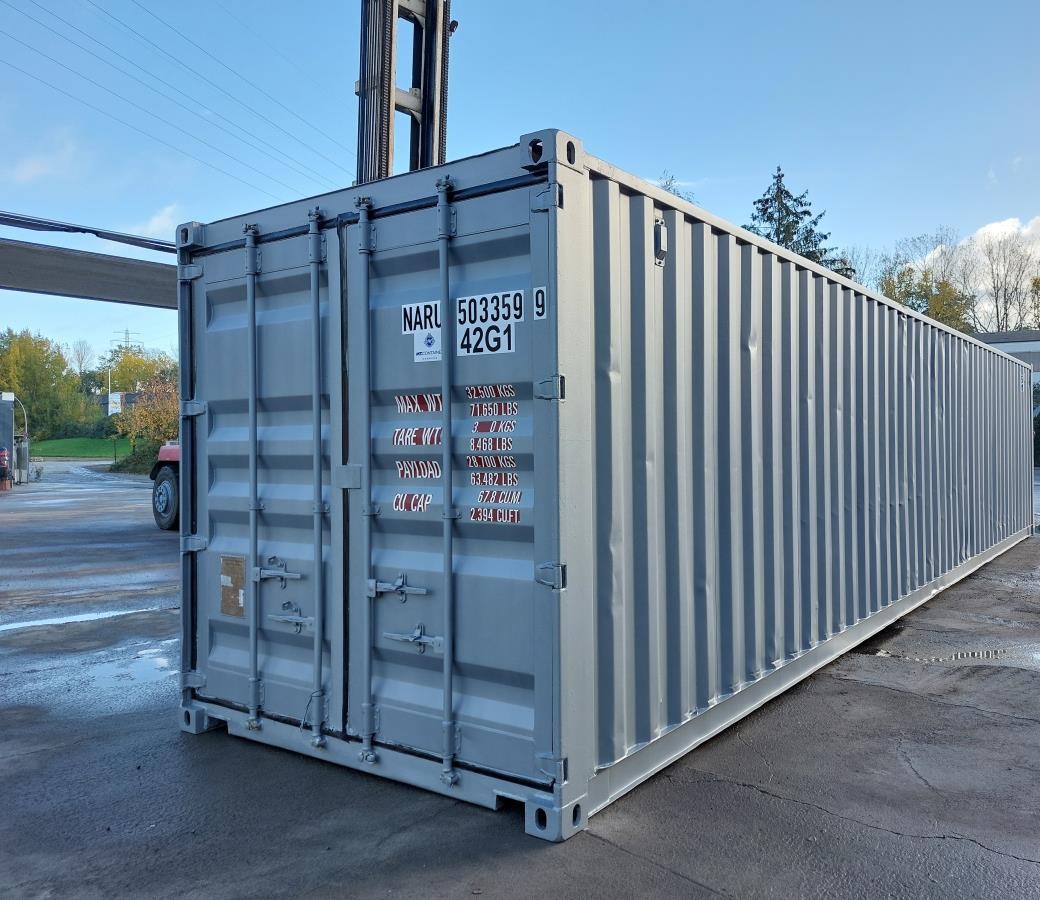
- 20 ft, 40 ft and 40 ft high cube, for general dry cargo
- Refrigerated containers (reefers)
- for temperature-controlled cargo
- Open top containers
- for tall cargo and cargo loaded from above
- Flat rack containers
- for heavy, wide or oversized cargo
- Tank containers
- for liquids in bulk
- Pallet-wide containers
- slightly wider inside, built to take Euro pallets more efficiently
- 45 ft containers
- for cargo that needs more length than a 40 ft container offers
Standard container
Closed steel box for general dry cargo.High cube
9 ft 6 in high instead of 8 ft 6 in.Reefer
Insulated, with a refrigeration unit at one end.Open top
Walls and doors, a tarpaulin instead of a roof.Flat rack
Floor and two end walls, open sides and top.Tank container
A tank for liquids inside a container frame.Which type is available depends on the location and the date. Tell us what you want to ship and where, and we will tell you which containers we can offer. Our guides explain three of the types in detail: reefer containers, flat rack containers and tank containers.
Where You Pick Up and Return Leased Containers
In Europe, you can pick up and return leased containers in Hamburg, Bremen, Bremerhaven, Rotterdam, Antwerp and Munich, among other places. Further locations are available on request. With a one-way lease, you can also return the container in Kazakhstan, Azerbaijan or Georgia.
If you wish, we arrange the transport through our transport partners: from the pick-up location to you, and from you to the return location.
The two locations are the first thing we need to know. They determine whether a one-way lease is possible on your route and what it costs.

Shipping Container Leasing in the United States
For customers in the US, we offer container leases through our US partner network, subject to availability. Quotes for US customers are in USD.
What you can lease in the US
- One-way lease from the US
- you pick up the container in the US and return it at another location in the US or abroad
- Long-term lease
- containers for an agreed fixed period in the US
- Lease with purchase option
- you can take ownership of the containers at the end on the agreed terms
- Container types
- the same types as in Europe, each subject to availability
Tell us where you need the container, for example your ZIP code or the port you ship from, and where you want to return it. We then check availability with our partner network. Our team responds in English.
Shipping in a Leased Container: What Shipping Lines Expect
When you book ocean freight, the shipping line normally supplies the container. The trade calls this a carrier-owned container, or COC. A leased container does not belong to the carrier. You book it as a shipper-owned container, or SOC. The term also covers containers that the shipper leases rather than owns. Three things change when you book.
- Announce the container when you ask for a freight quote. Hapag-Lloyd, for example, requires shippers to announce an SOC when they ask for a quotation, and its quotations for SOC shipments are valid for SOC shipments only.
- The container must be approved for transport. Hapag-Lloyd, for example, requires a valid CSC plate and CSC certificate. The CSC plate is the safety approval plate under the International Convention for Safe Containers. Maersk asks for an application form, photos of the container and photos of its CSC plate with the booking. Hapag-Lloyd also expects ISO standard dimensions and a standard container number with four letters, six digits and a check digit.
- The time you may keep the container is set in your lease. With a carrier’s container, the carrier grants free time and can charge detention once it has expired. The US Federal Maritime Commission describes detention as a charge for the extended use of equipment, and demurrage as a charge that accrues when a container stays on a marine terminal beyond the free time. With a leased container, how long you may use it and what that costs is agreed between you and the lessor. Port or terminal storage charges can still apply.
Who keeps the container’s examinations up to date?
A safety-approved container has to be examined periodically, and the International Convention for Safe Containers makes the owner responsible for this. For containers approved as new, 49 CFR 452.1 requires the first examination within five years of manufacture and later examinations at intervals of no more than 30 months, subject to the exception in 49 CFR 452.7. US law adds that the term “owner” includes a lessee if a written lease assigns the owner’s responsibility for maintaining and examining the container to the lessee. A lease can therefore place the duty on either side. Your lease agreement should say who has it.
Reefers can come with extra requirements. If an SOC reefer is not from the same manufacturer as Hapag-Lloyd’s fleet, the carrier wants to know which refrigeration unit you will use. It also asks for a spare parts kit, a manual, an emergency procedure and crew training at the customer’s expense before loading, among other things. If you plan to ship cargo in a leased reefer, talk early to your carrier or to the freight forwarder who books the shipment for you.
What Does It Cost to Lease a Shipping Container?
Container leasing rates depend on the container type, the term, the pick-up and return locations, and the quantity. That is why we do not publish flat prices. Prices are available on request, and the terms are stated in your individual quote.
For a one-way lease, the route affects the quote. Leasing companies also use one-way leases to move containers from places with low demand to places with high demand. The same container can therefore be quoted differently on two routes.
Words you will find in lease quotes
- Per diem
- a rate per container and day
- Free days
- a number of days negotiated between lessor and lessee; each agreement defines what they cover
- On-hire and off-hire
- the start and the end of the lease for a container, at pick-up and at return
- Pick-up and drop-off charges or credits
- amounts that depend on where a container is picked up and where it is returned
- Damage protection plan (DPP)
- an additional cover that a lessor may offer under certain agreements against certain damage, cleaning and repair charges at off-hire
Leasing companies and trade guides use these words. We list them so that you can read and compare quotes. The list does not describe the conditions of our leases. Which items your lease contains, and at what amounts, is stated in your quote.
Lease or Buy? And What About Rental?
| You pay | At the end | Fits | |
|---|---|---|---|
| Lease | a lease rate for the agreed term | you return the container, or keep it if your lease has a purchase option | one trip or a project with an agreed period |
| Buy | the purchase price | the container is yours to keep, reuse or resell | permanent use |
Leasing has a price. According to the textbook cited above, leasing a container is more costly than owning it from an operational standpoint. That is why leasing suits one trip or a limited period.
If you need a container permanently, buying is usually the simpler route. Our shop lists shipping containers for sale.
Rental is a third term you will come across. It usually means a container that stands on your own site, for example as storage on company premises or on a construction site: the container is delivered and collected again later. This page is about leasing containers for transport.
How to Get a Lease Quote
Four steps from inquiry to return
- Inquiry. Tell us the lease model, the container type, the quantity, the pick-up location, the destination or return location, and the period.
- Quote. You receive a quote with the lease rate and the additional charges.
- Pick-up. You pick up the container at the agreed location, or we arrange the transport through our transport partners.
- End of term. You return the container at the agreed location, or you take ownership of it as agreed.
What to settle with a container leasing company before you sign
- Term: when the lease starts and when it ends
- Condition: the condition of the container at pick-up and the condition expected at return
- Damage: the rules that apply if the container is damaged
- Billing: the lease rate, how it is billed and every additional charge
- Locations: the exact pick-up and return locations
- Examinations: who keeps the safety examination of the container up to date
- Cargo: whether your cargo needs special approval, for example dangerous goods
We set out the term, the condition of the containers at pick-up and return, the billing and the rules for damage in the quote and the lease agreement. That way, you know what applies before you sign. Ask us about examinations and special cargo as well, because they depend on the container and the route.
Get a lease quote
Tell us what your business needs and complete the fields marked *. Our team responds in English.
Please note: Your contact details will be stored and only used to respond appropriately to your enquiry and as required by law. See our privacy policy.
Shipping Container Leasing FAQ
What is container leasing?
Container leasing means using a shipping container for an agreed term in return for a lease rate, without buying it. At the end of the term, you return the container or, if your lease includes a purchase option, keep it.
How much does it cost to lease a shipping container?
There is no flat price. The lease rate depends on the container type, the term, the pick-up and return locations, and the quantity. We quote on request. Quotes for US customers are in USD.
What is a one-way lease?
A one-way lease is a lease for a single trip. You pick up the container at one location, load it and return it at the destination, so the empty container does not have to travel back.
Can I lease just two or three containers?
Yes. You can lease just two or three containers from MT Container.
Can I keep the container at the end of the lease?
Yes, if you choose a lease with purchase option. After the agreed term, you can take ownership of the containers. The terms are stated in your quote.
Where can I pick up and return leased containers?
In Europe, in Hamburg, Bremen, Bremerhaven, Rotterdam, Antwerp and Munich, among other places. Further locations are available on request. With a one-way lease, you can also return the container in Kazakhstan, Azerbaijan or Georgia. In the US, we offer leases through our US partner network, subject to availability.
How long does a container lease run?
A one-way lease covers one trip. Any other lease runs for an agreed fixed period. The term is stated in your quote and in the lease agreement.
What is the difference between leasing and renting a container?
In everyday language, the two words overlap. On this page, leasing means containers for transport, for one trip or for an agreed term. Rental usually means a container that is delivered to your site, stays there as storage and is collected again later.
Can I lease shipping containers in the US?
Yes. For customers in the US, we offer one-way leases, long-term leases and leases with purchase option through our US partner network, subject to availability. Quotes are in USD.
Who is my contracting party?
Your contracting party is MT Container GmbH in Hamburg, Germany. Our leasing service is for companies and other commercial customers.
Sources
Retrieved in November 2026.
Show all 12 sources
- Notteboom, Pallis and Rodrigue: Port Economics, Management and Policy, 2nd edition (2026), Characteristics of Container Leasing Arrangements (share of the fleet owned by leasing companies, lease categories, on-hire and off-hire, cost of leasing compared with owning)
- VS&B Containers: An Overview of Container Leasing Arrangements in the Shipping Industry (one-way leases); SOC vs COC Containers (shipper-owned and carrier-owned containers)
- Hapag-Lloyd: Shipper Owned Container Terms (PDF) (announcing an SOC, CSC plate, container number, reefers)
- Maersk: Do you accept Shippers own containers? (documents at booking)
- US Federal Maritime Commission: Detention and Demurrage; 46 CFR 541.3 (definitions)
- International Maritime Organization: International Convention for Safe Containers (CSC) (safety approval plate, owner’s responsibility)
- 46 U.S.C. 80501 (definition of owner); 49 CFR 452.1 (periodic examination)
- Bureau International des Containers: Identification number; Size and type codes
- Seaco: Container Leasing (sale and leaseback, damage protection plan)
- LOTUS Containers: Types of Container Leasing; freightcourse: How to Lease a Shipping Container (free days, per diem, pick-up and drop-off locations)
- Wikipedia: Intermodal container (pallet-wide containers)
- MT Container: own lease terms and locations
Need containers for one trip or for longer?
Tell us the container type, the quantity, where you want to pick up and return the containers, and the period. Our team responds in English.
MT Container GmbH, Hamburg, Germany. Trading containers since 2008.