
Shipping Container Shelving: Plan Storage Without Blocking Access
Compare aisle layouts, shelving types and manufacturer load examples before equipping your storage container.
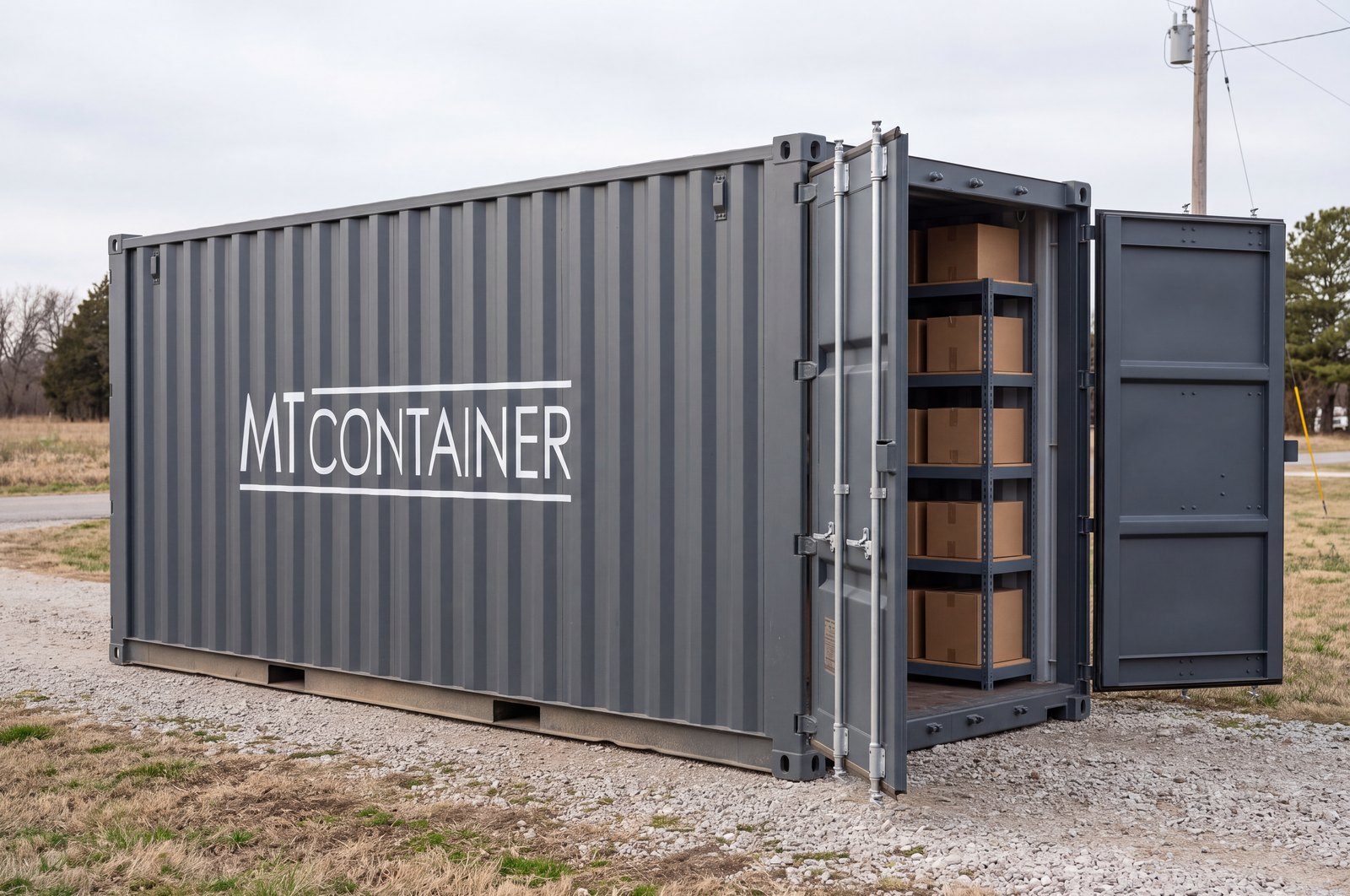
Updated November 2026 · Storage planning for US buyers
Plan the Route Before You Pick Shelves
Plan shipping container shelving around what you need to retrieve. Two 18 in runs leave a calculated 56.5 in aisle in our 20 ft example. Test your largest loaded box or cart through the doorway before choosing shelves.
List item sizes, weights and retrieval frequency; allow space for handles and lifting.
Calculate Shelf Depth and Aisle Width Together
The 20 ft reference in Hapag-Lloyd’s archived specification has an interior that is 232.1 in long, 92.5 in wide and 94.2 in high (5,895 × 2,350 × 2,392 mm). Measure your actual container, including lining.
Clear aisle = usable interior width − left projection − right projection. Measure each projection from the wall to the farthest shelf, foot, handle or stored item. Include the stand-off, meaning the gap behind the rack, in that measurement.
| Layout | Left projection | Right projection | Calculated aisle |
|---|---|---|---|
| One deeper run | 24 in (609.6 mm) | 0 in (0 mm) | 68.5 in (1,740.4 mm) |
| Two shallower runs | 18 in (457.2 mm) | 18 in (457.2 mm) | 56.5 in (1,435.6 mm) |
| Two deeper runs | 24 in (609.6 mm) | 24 in (609.6 mm) | 44.5 in (1,130.8 mm) |
These are our calculations from the unrounded 2,350 mm width, not prescribed aisle widths. Tape the layout on the floor and test retrieval. For US workplaces using mechanical handling equipment, OSHA 1910.176(a) requires safe clearances and unobstructed aisles. Check applicable exit and accessibility requirements separately.
Plan the Doorway and the Far End
The 20 ft reference doorway is 92.1 in wide × 90.2 in high (2,340 × 2,292 mm). That makes it about 3.9 in (100 mm) lower than the interior; the inch figure is calculated from the millimeter values. Check rack height, assembly sequence, threshold and door-opening space before purchase.
For 40 ft container shelving, the current Hapag-Lloyd reference is 473.7 in long, 92.6 in wide and 94.3 in high inside (12,032 × 2,352 × 2,395 mm). Its doorway is also 92.1 in wide × 90.2 in high (2,340 × 2,292 mm), a calculated 4.1 in (103 mm) lower than the interior. Two 24 in projections leave a calculated 44.6 in (1,132.8 mm) aisle.
High Cube means a taller container. The manufacturer’s CIMC-20HC specification lists an interior 232.2 in long × 92.6 in wide × 106.2 in high (5,898 × 2,352 × 2,698 mm). The CIMC-40HC specification lists 473.7 × 92.6 × 106.2 in (12,032 × 2,352 × 2,698 mm). Both doorways are 92.1 in wide × 101.8 in high (2,340 × 2,585 mm), a calculated 4.4 in (113 mm) below the interior height. Check the doorway before choosing an assembled rack; extra interior height alone does not establish a safe rack height. These are model examples, separate from the standard-height drawings.
The drawings reserve 48 in (1,219.2 mm) at the entrance. The rear allowance is 12 in (304.8 mm) in the 20 ft example and 24 in (609.6 mm) in the 40 ft example. That leaves a shelving run of 172.1 in (about 14.3 ft; 4,371 mm) along each wall in the 20 ft example and 401.7 in (about 33.5 ft; 10,203.2 mm) in the 40 ft example. These are chosen allowances; test loading and turning. The drawings show space reserved for shelving, not a construction design.
Choose a Mounting System Before Buying Shelves
Four shelving types and example loads
These are manufacturer examples, not container-floor approvals. Metro specifies evenly distributed loads. Except for #3210, kilograms below are our conversions, rounded to whole kilograms. The manufacturers print rounder metric figures (Metro: 900 kg and 450 kg per unit; INSTA #1210: 250 kg per arm). The pound ratings are the reference; where the kilogram figures differ, use the lower one.
| Shelving type | Example | Per shelf | Whole unit |
|---|---|---|---|
| Freestanding steel racks | Metro Super Erecta, shelves 24–48 in (609.6–1,219.2 mm) long | 800 lb (363 kg) | 2,000 lb (907 kg), stationary |
| Rolling racks | Metro Super Erecta, mobile | 800 lb (363 kg) | 1,000 lb (454 kg), depending on configuration and casters |
| D-ring systems — technical reference | INSTA #1210, two brackets carrying one shelf | 1,100 lb (499 kg), at 550 lb (249 kg) per arm | 1,100 lb (499 kg), the same single level |
| D-ring systems — US model | INSTA #3210, two three-tier brackets | 550 lb (250 kg) per bracket arm, manufacturer-printed kg | 2,200 lb total across the two-bracket set |
| Workbench with shelving | IAC Dimension 4 workstation | 75 lb (34 kg), solid-surface metal shelf | 750 lb (340 kg), including attached accessories and their contents |
Sources: Metro’s shelving instructions, INSTA’s #1210 data sheet, INSTA’s #3210 data sheet and IAC’s Dimension 4 load specifications. Use the boards INSTA specifies. The #1210 sheet states that this model cannot be shipped to the US, so treat its figures as a technical example only.
In its February 2026 review of 2025, INSTA reported the re-introduction of its shelf brackets to the US market. One D-ring model is the #3210, a multi-level bracket set; its data sheet carries no US shipping exclusion. Confirm US delivery for the exact model with the manufacturer before ordering.
For #3210, 250 kg is printed beside the 550 lb arm rating. The sheet gives 2,200 lb for the complete two-bracket system and prints “1 ton,” without a kilogram total. Keep that overall limit across all three tiers; it is not a per-tier rating. Confirm load distribution and board specifications with INSTA.
Container shelving brackets without drilling
Purpose-made hanging systems hook onto the existing D-rings, the internal cargo-securing loops, so the brackets are not welded to the container. Ask the supplier whether any part of the system still needs drilled fixings. INSTA’s installation explanation shows this approach. Confirm ring compatibility, supports and boards with the supplier.
Hapag-Lloyd’s specification describes the rings as lashing devices for cargo securing. Their lashing rating alone does not approve a hanging shelf; ask the system supplier to verify the load path and ring condition.
Freestanding racks and DIY shelving
Follow the manufacturer’s leveling and restraint instructions. For DIY shelving, have a structural engineer assess custom connections and load transfer before buying materials.
Check Loads at the Shelf, Support and Floor
A uniformly distributed load is spread across the shelf. Machines and concentrated stacks need separate assessment. Keep heavy items low; follow the specified load distribution.
Include rack weight when assessing loads through feet or wheels. The Hapag-Lloyd loading guidance relates floor loading to the length supporting the cargo. Ask the container supplier or a structural engineer to assess floor condition, supports and load spreading. A container’s payload, the maximum cargo weight for the whole unit, is not a shelf rating.
These are stationary-storage layouts. Before transport, confirm securing with the supplier and carrier. Keep inspection access and vents clear. Shelves alone do not control moisture; EPA guidance explains moisture reduction, air movement and insulating cold surfaces.
Check the Container and Request a Quote
Before purchase, request photos of the floor, rings, doors and repairs. US condition terms describe different things: “new/one trip” follows an initial cargo journey; “cargo worthy” concerns transport suitability; “wind and water tight” concerns weather entry; “as is” can include unresolved defects. Get the unit’s condition in writing; sources below.
MT Container has been trading containers from Hamburg, Germany, since 2008. On a construction site in Hamburg, one 10 ft and three 20 ft containers from us went into use in 2024 as lockable storage for tools and materials. We also made a container delivery for a furniture workshop in Herten, Germany. These are container-supply references; the shelving layouts here are our planning examples.
Used and new (one trip) 10 ft, 20 ft and 40 ft containers are sourced through our US partner network, subject to availability. Offers are priced in USD. Our team responds in English. Send your ZIP code, contents, item measurements and layout. Our quote covers the container. Shelving is not a standard part of our US offer; if you need it supplied or installed, state that as a separate request so we can confirm whether it is possible.
US delivery is by container truck. Confirm unloading, access, turning space and a firm, level placement area; see the delivery source below.
Shipping Container Shelving Questions
Can you install shipping container shelving without drilling?
Often yes: use a compatible container-specific hanging system, installed to its instructions. Confirm the actual rings and the complete loaded arrangement with its supplier.
How wide should the aisle be?
Wide enough for your handling route and applicable requirements. In our 20 ft calculation, the two 18 in runs leave 56.5 in; test the loaded cart and retrieval movements before choosing.
How much shelving fits in a 20 ft container?
In our example, each side wall takes a shelving run of 172.1 in (about 14.3 ft). That reserves 48 in at the doors and 12 in at the rear. Two 18 in projections then leave a 56.5 in aisle. Measure your own container before ordering.
How much weight can container shelves hold?
The lowest applicable limit governs: Metro’s mobile example is capped at 1,000 lb overall (Metro prints 450 kg), even with two 800 lb shelves. Also check attachments and floor loads.
Sources and Scope
Sources reviewed 2026-11-26. Dimensions come from the Hapag-Lloyd references linked above: an archived 20 ft specification and the current 40 ft page. High Cube examples come from the linked CIMC manufacturer specifications. Dimensions vary by unit. Conversions use 25.4 mm per inch and 2.20462 lb per kg, rounded after calculation. Layout allowances are our assumptions. Company statements come from MT Container’s own records.
- Technical sources are linked beside their use.
- Condition terminology: Container One terms and Conexwest condition guide. Their warranties remain their own.
- Site preparation: Eveon delivery guidance; confirm the arrangements for your MT order.