
Shipping Container Sheds: Plan Storage You Can Use
Choose the container around what you store and how you reach it. Check the layout, condition and site before planning shelves or modifications.
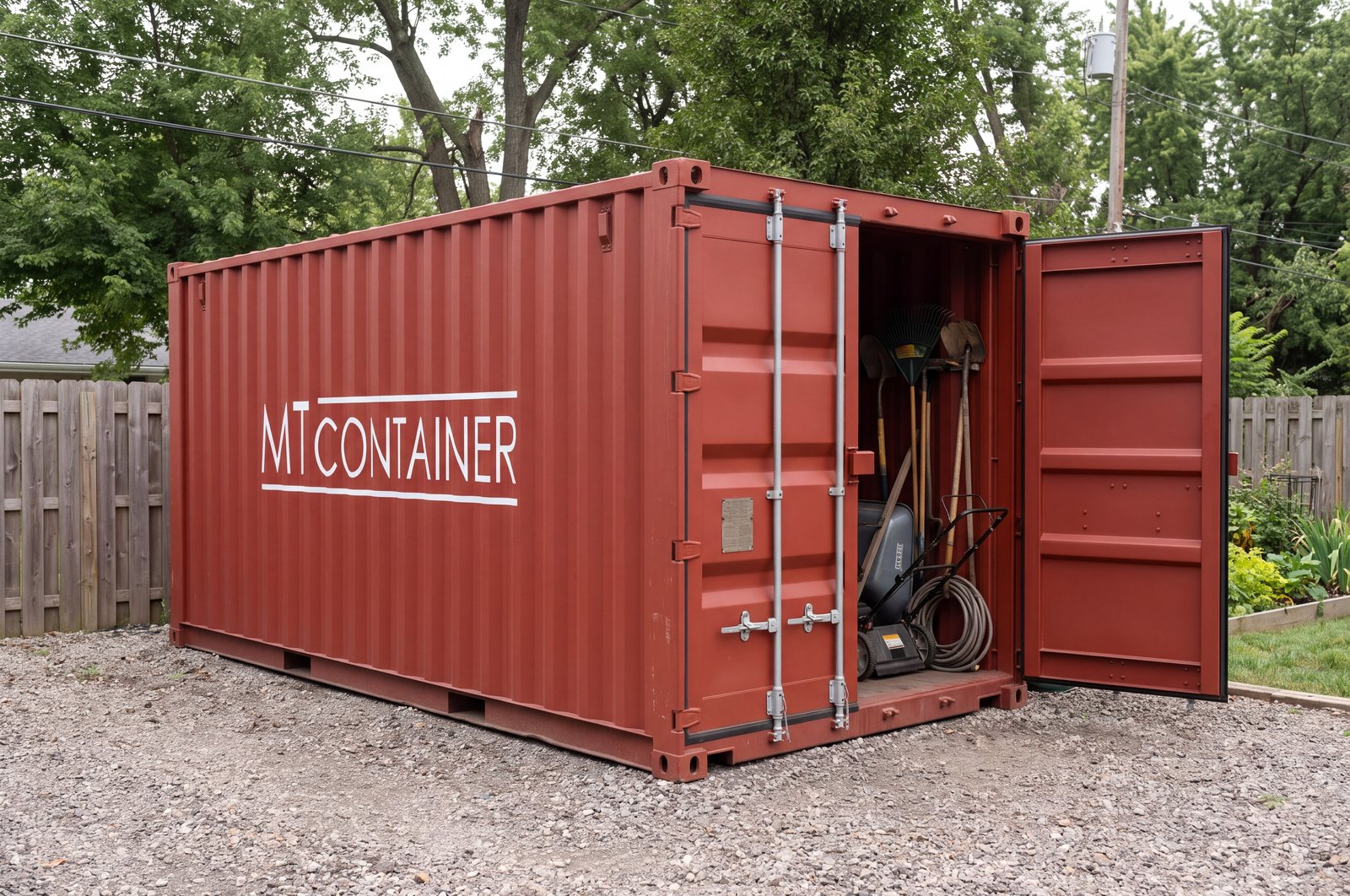
Updated November 2026 · Storage planning guide
- Start here
- Compare sheds
- Size and access
- Condition
- Site and delivery
- Moisture
- Doors and care
- MT experience
- US quote
- Questions
- Sources
Is a Shipping Container Shed Right for Your Property?
A shipping container shed uses a container as an enclosed storage space for tools, equipment or belongings. It makes sense when the shell, delivery route and daily access fit your needs. Decide what must stay dry, what needs temperature control and what you need to reach easily.
This guide covers storage. Garages need vehicle access; workshops need working space, power and suitable conditions. A roof between containers needs its own structural and approval plan.
Container or Conventional Shed?
- Choose a container when: you want an existing enclosure, can accommodate truck delivery and can organize your storage within its shape.
- Consider a conventional shed when: the site needs a particular footprint, a roofline that matches the house or a custom entrance.
- Compare the finished result: compare the total for ready-to-use storage in both quotes. The cost items are listed below.
| Planning point | Container | Conventional shed |
|---|---|---|
| Footprint: | Container: fixed by the unit you choose; | Conventional shed: can be planned for the site |
| Arrival: | Container: delivered as an existing enclosure by truck; | Conventional shed: built on site, or assembled from a kit |
| Entrance: | Container: cargo doors; double-door or open-side units subject to availability; | Conventional shed: door position can be planned with the design |
| Moisture: | Container: needs leak checks and a condensation plan; | Conventional shed: needs leak checks and a condensation plan too |
| Costs to compare: | Container: unit, delivery, unloading, site work, approvals, repairs, modifications; | Conventional shed: shed or kit, assembly, base, site work, approvals |
Sketch the daily route from the driveway to your stored items. If reaching a toolbox means moving the mower, revise the layout before ordering a larger unit.
Choose the Size Around Access
Measure your largest item, including handles, attachments and turning space. Put frequently used items near the doors and long-term storage at the back. Mark a clear path to reach your stored items.
A 10 ft shipping container can suit a small storage need. Compare a 20 ft or 40 ft unit when you need more length. These names identify size classes. Ask for the actual floor dimensions and clear door opening before selecting equipment or shelving.
For taller items, compare standard height with a 20 ft High Cube or 40 ft High Cube, the taller container type, subject to availability. Confirm the actual door opening as well as interior height.
Reference sizes and clear door openings
Standard-height reference examples, not specifications for an offered unit. Interior dimensions are length × width × height; clear door openings are width × height. Inches are our conversions, rounded to 0.1 in. Interior lengths are about 9 ft 4 in (10 ft), 19 ft 4 in (20 ft) and 39 ft 6 in (40 ft). Floor areas, by our own calculation, are about 72, 149 and 305 sq ft. In each reference, the door opening is about 4 to 4.4 in (100 to 113 mm) lower than the interior height.
| Size | Interior: length × width × height | Clear door opening: width × height | Source |
|---|---|---|---|
| 10 ft: | 111.8 × 92.5 × 94.2 in (2,840 × 2,350 × 2,393 mm); | 92.2 × 89.8 in (2,342 × 2,280 mm); | Manufacturer specification [A] |
| 20 ft: | 232.1 × 92.5 × 94.2 in (5,895 × 2,350 × 2,392 mm); | 92.1 × 90.2 in (2,340 × 2,292 mm); | Carrier data via TIS [B] |
| 40 ft: | 473.7 × 92.6 × 94.3 in (12,032 × 2,352 × 2,395 mm); | 92.1 × 90.2 in (2,340 × 2,292 mm); | Carrier specification [C] |
A shelving example you can check
Our example uses a published 20 ft reference interior: 232.1 in long by 92.5 in wide (about 19 ft 4 in by 7 ft 8.5 in; 5,895 × 2,350 mm) and 94.2 in high (2,392 mm), with a door opening 92.1 in wide by 90.2 in high (2,340 × 2,292 mm), from TIS standard-container data. In this reference, the door opening is about 4 in (100 mm) lower than the interior, so a tall shelf unit can fit inside and still not pass through the door upright. The floor area is about 149 sq ft (13.85 m²), by our own calculation. Use the offered unit’s measurements for your final layout.
Assume each shelving run projects 18 in (457.2 mm) into the room, measured from its side wall and including any stand-off (the gap between shelf and wall). Two runs leave 56.5 in (about 4 ft 8.5 in; 1,435.6 mm) between them. That is our own calculation, with inches rounded to 0.1 in. It is not a required aisle width or an accessibility approval. Check your equipment, shelf feet and handling space against the actual unit.
The drawing leaves a loading area at the doors. Label storage zones and keep edges accessible for inspection. Ask how the shelving will be anchored and what loads the shelves and floor can carry.
- 1Shelving projection: 18 in per side, including the gap to the wall.
- 2Space between runs: 56.5 in before practical clearances.
- 3Loading area: allow space for your equipment and handling method.
Check the Unit Before Planning the Interior
Request recent photos of the specific container, including the roof, door seals, floor and repairs. Ask about holes, corrosion, door operation, floor damage, odors and known previous use. Use those details to judge suitability for your contents.
US sellers use condition descriptions that need to be read with their terms:
- New / one trip: generally a new container that carried an initial cargo shipment; handling marks may still be present.
- Cargo worthy: describes a structurally sound container with working doors; ask what inspection and transport documents support that description.
- Wind and water tight: describes a container that keeps wind and rain out; check shipping approval separately if transport is planned.
- As is: defects may remain. Ask exactly what is excluded and whether repairs would make the unit suitable for your storage.
Compare the published seller explanations listed in Sources and Scope. Their grading and warranty terms differ; they are cited as published sources only. For an MT US purchase, the partner states the condition class of the individual unit in writing.
Sort Out Permits, Delivery and the Base First
Before ordering, give the local zoning and building departments a site sketch, intended storage use, container size and intended duration. Ask about permits, placement restrictions, setbacks and any foundation or anchoring requirements. Check HOA rules and deed restrictions separately. Ask how the proposed unit and storage use are classified.
Local examples show why checking matters: Humboldt County, Nevada’s storage-container handout states that a building permit is required before installation. Fairfax County, Virginia’s portable-storage rules allow portable storage containers only as a temporary use on lots with a dwelling. These are local examples; confirm the requirements for your property.
Prepare a firm, level placement area with suitable drainage. Have the support arrangement assessed for the unit, its load and local ground conditions; follow a manufacturer or seller support plan if one is supplied.
If you choose delivery for an MT US order, the container arrives by container truck. The unloading method has to be worked out for your site. Send route photos and measurements: gates, turns, overhead obstacles, slopes and the unloading area. Confirm ground suitability and door orientation before scheduling. Published seller delivery guidance listed in Sources and Scope illustrates these checks; confirm MT delivery arrangements in your quote.
Keep Rain, Condensation and Stored Moisture Separate
Water inside can come from a leak, condensation or wet contents. Check seals and openings after rain, note where moisture appears and dry wet items before storing them. Trace each damp patch to its source.
Condensation can form when humid air meets a cold surface, as explained in the EPA mold course (Chapter 2). Measure temperature and humidity to assess the space for sensitive contents.
Ventilation, insulation and dehumidification solve different parts of the problem. Choose a combination for the climate and storage needs. The EPA’s moisture-control guidance discusses reducing moisture, air movement and insulating cold surfaces. Check the storage instructions for electronics, documents, seed or other sensitive goods.
MT also offers insulated containers sourced through our US partner network, subject to availability. These are former refrigerated containers with the refrigeration unit removed and the machinery opening closed off. Temperature-sensitive goods may need active climate control as well.
- 1Rain entering through a defect or opening.
- 2Condensation on a cool surface.
- 3Moisture introduced with wet contents.
Plan Doors, Security and Upkeep
Confirm that both cargo doors can open in the proposed location and that their handles are usable. For wheeled equipment, assess the threshold and a suitable ramp with the supplier. Specify the equipment and load when choosing the ramp.
Check the lock arrangement, hinges, seals and any added openings together. Ask whether the unit has a lockbox, a protective housing for a compatible lock. Ask your insurer about the intended contents and required protection. Keep access and inspection areas clear as plants grow and storage needs change.
If you want another entrance, such as a roll-up door or a side door, compare a double-door or open-side container, subject to availability, before having an opening cut. Have proposed alterations reviewed for structural effects, weather sealing and applicable requirements. This guide does not promise modification work in the US; ask about it in your quote request.
After placement, check the doors before loading. During use, check seals, corrosion and drainage, particularly after severe weather. Keep photos to track changes.
What MT Has Supplied for Storage
Starting in 2024, a construction site in Hamburg, Germany, used one 10 ft and three 20 ft containers from MT as lockable storage for tools and materials. MT has traded containers from Hamburg, Germany, since 2008.
Request a Container for a US Storage Project
MT offers used and new (one trip) 10 ft, 20 ft, 20 ft High Cube, 40 ft and 40 ft High Cube dry containers, including double-door and open-side units, sourced through our US partner network, subject to availability. Dry means non-refrigerated here. Pickup or delivery in the US is available; quotes are in USD. Our team responds in English.
Send the destination ZIP code, preferred size and condition, contents to be stored, largest item dimensions and site-access photos. Mention shelving, temperature-sensitive contents and proposed alterations. Ask for a quote that lists the container, transport, unloading and any agreed work as separate items.
For business storage projects, see our container leasing options.
Shipping Container Shed Questions
How do I turn a shipping container into a shed?
Work in this order. First, ask your local zoning and building departments about permits and placement. Second, choose the size around your largest item and the door opening. Third, check the specific unit: roof, door seals, floor and repairs. Fourth, prepare a firm, level area with drainage and confirm the truck route. Fifth, after placement, check the doors, then add shelving and a moisture plan before loading.
Is a container shed cheaper than a regular shed?
Not always. Compare complete quotes for the same usable storage space. A low container price can be outweighed by difficult access, repairs or a substantial interior setup. A shed kit may need assembly and a base that its advertised price excludes.
Do I need insulation for a tool shed?
Not in every case. Start with the tools’ storage requirements and the site’s temperature and moisture conditions. Assess insulation alongside leak repairs, moisture management and any active temperature control needed.
Do I need a permit for a shipping container shed?
It depends on your location. Humboldt County, Nevada, states in its storage-container handout that a building permit is required before installation. Fairfax County, Virginia, allows portable storage containers only as a temporary use on lots with a dwelling. Ask your local zoning and building departments how they classify your proposed container and use before you order.
Do shipping container sheds get condensation?
They can. Condensation may form when warm, humid air meets a cold surface, and a weather-tight shell does not control humidity. Dry wet items before storing them and track conditions with a temperature and humidity meter.
Can I put a roof between containers?
That creates a separate structure. Have its loads, connections, supports and local approval requirements assessed before purchase. This guide does not cover roof design; plan it as a separate project with a qualified designer.
Sources and Scope
Sources checked 2026-11-26. Linked specifications describe reference containers. Size references [A] to [C] were retrieved on November 19, 2026. Calculations and drawings illustrate storage planning; structural design requires a separate assessment. MT company information supports the German storage example and the stated US sourcing offer. The photograph shows an unmodified container with open cargo doors.
- [A] Bullbox: 10 ft manufacturer specification, Dimensions and Ratings.
- [B] TIS: Hapag-Lloyd standard-container data, first 20 ft reference row.
- [C] Hapag-Lloyd: 40 ft Standard, reference interior and door opening.
- Condition descriptions: Container One: terms and conditions and Conexwest: container conditions.
- Delivery planning: Eveon: delivery requirements.