
Shipping Container Locks: Choosing and Checking Security
Compare lock types, check example shackle dimensions and inspect the container doors before choosing security hardware.
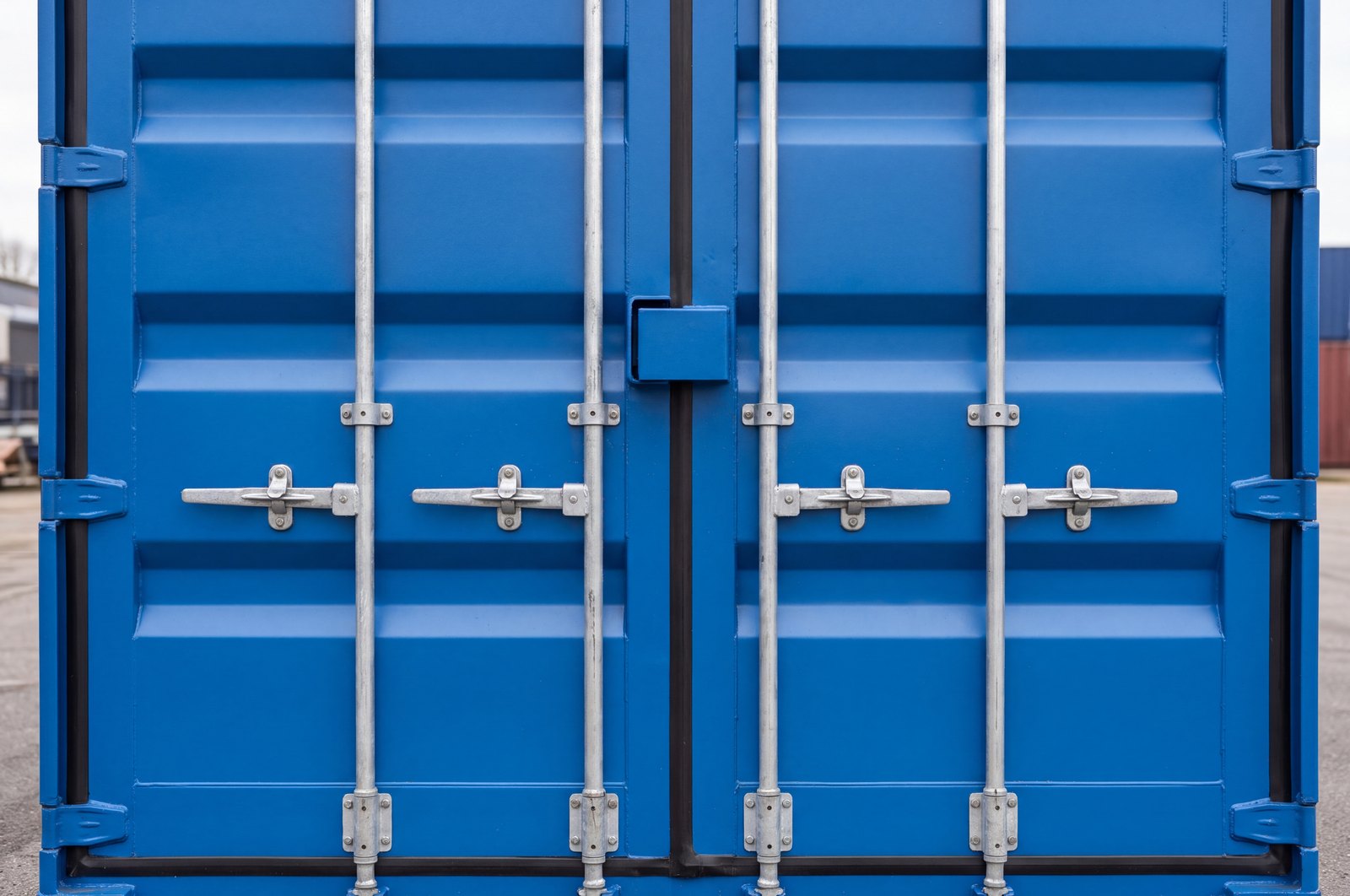
Updated November 2026 · A security guide for US container owners
Choose the Lock Around the Door and the Site
Start with a shipping container lock that fits the locking point on your doors, protects its shackle and suits outdoor use. On a shipping container, also called a Conex box, check the door hardware and the site around it as well. For storage, compare two options: a compatible padlock inside a steel lockbox, or a purpose-made bar lock across the door rods. Match your choice to the contents and your access routine.
This comparison explains how to choose; it is not a tested security ranking.
Compare Shipping Container Lock Types
Two terms first. The shackle is the bar or pin of a padlock that passes through the locking point. The hasp is the fixed metal fitting on the door that the shackle passes through.
| Lock type | How it works | What to check |
|---|---|---|
| Shrouded-shackle padlock | A cover limits exposure of the shackle | Hasp opening, shackle clearance and space around the cover |
| Straight-shackle padlock | A straight pin closes the locking point | Pin diameter, usable clearance and access to the key inside the box |
| Hidden-shackle or puck lock | The body encloses the shackle | Rear profile and engagement point against the intended hasp |
| Door bar lock | An external assembly joins the vertical door rods | Rod spacing, rod shape, adjustment range and clearance from the handles |
Compare the complete assembly using manufacturer drawings and a trial fit. Sources: shrouded-shackle design, hidden-shackle design, straight-shackle design and the hardware references below.
Check the Lockbox and Fit Before Buying
A container lockbox is a steel enclosure around the locking point. Ask for close-ups of its opening and attachment points, with the doors closed and open.
Make a fit record for the supplier: the available width, height and depth inside the box; the hole or slot size; the reach needed to engage the fitting; and the room to insert, turn and remove the key. For a bar lock, record the rod spacing at the measuring points the manufacturer specifies.
Example dimensions, not a universal fit: available space varies by container and lockbox. The manufacturer drawing for the Bloxwich BCP17006/1 lockbox gives overall dimensions of 7.2 × 4.3 × 2.4 in (182 × 110 × 60 mm), plus a 0.8 in (20 mm) padlock hole. These are outside dimensions and a hole diameter, not usable interior dimensions, so measure the inside of the installed box.
- Master Lock 6321: shackle diameter 5/16 in (8 mm), shackle length 3/4 in (19 mm) and shackle width 7/8 in (22 mm), as listed by the manufacturer.
- ABUS 92/80: shackle diameter approximately 0.5 in (12 mm), vertical clearance 0.7 in (17 mm) and horizontal clearance 1.5 in (37 mm). Kronsguard documents this model with its nw4 lockbox (data sheet in German); that pairing does not establish fit in another box.
The decimal inch values are our own conversions, rounded for orientation. For selection, use the original millimeter values and a trial fit. A matching hole diameter alone does not establish fit.
Have the installer confirm the attachment method, the alignment and the finished operation. Both welded boxes and bolt-on assemblies exist; the choice depends on the specific product and door. For a rented container, get the owner’s agreement before altering it.
Inspect the Door Hardware Before Adding Security
The handles turn the vertical locking rods. At each rod end, a cam (a shaped lug) turns into a keeper (its bracket on the frame) and holds the door shut. Inspect the rods, handles, hinges and attachment points. Look for loose fittings, distortion and corrosion, and check that the doors close with the hardware properly seated.
If a door binds, have the door hardware and the ground support under the container checked. Uneven placement can distort the opening; damaged components and seals can also affect operation. Resolve the cause before you select additional locking hardware. Source: CTU Code (the international code for packing cargo transport units), Annex 5, paragraphs 6.7 to 6.14, door operation (PDF page 86).
Make the Site Part of the Security Plan
Position the entrance where your security arrangements can cover it, and check the sightlines again after vehicles and materials arrive. Include the container in the site’s fencing, gate control, lighting and monitoring plan. Decide who receives alerts and what action follows them.
For valuable tools or an unattended site, review the whole setup with your security adviser and insurer. Ask for written requirements for the contents, the site and the hardware. The illustration is a planning aid: camera coverage, lighting and barriers need a site-specific layout. See Travelers’ construction-site guidance.
Manage Keys, Weather Exposure and Daily Checks
Keep a record of issued keys and name one person responsible for locking up. Decide how access changes when someone leaves the team. If several locks share a key, record every door that key opens. For a combination lock, assign responsibility for changing and sharing the code. Decide who carries the key at lock-up; some locks require it to close.
Choose hardware specified for its exposure and follow its care instructions. A stiff key or an unreliable mechanism needs attention before the next lock-up. Use the lubricant recommended for that lock: Master Lock, for example, advises against dry graphite and silicone lubricants. Source: manufacturer maintenance guidance.
Before leaving, confirm that everyone is outside, the doors and handles are seated, the lock has engaged, the key or code is secured, and the site’s agreed monitoring is active. Keep the route out clear while the container is in use.
A Storage Example from Hamburg
On a construction site in Hamburg, Germany, MT supplied three 20 ft containers and one 10 ft container as lockable storage for tools and materials. The containers were secured with VdS locks; the recorded use began in 2024. This is not a measured burglary-resistance result.
VdS is a German testing and certification body for security technology.
For a new project, verify the exact lock, the fittings and any approval documents together. Some approvals apply only to specified hardware combinations. The Hamburg case is not a US certification.
Shipping Container Lock Questions
What is the best lock for a shipping container?
No single lock suits every container. Choose a protected locking arrangement, such as a padlock inside a steel lockbox or a bar lock across the door rods, that fits your doors and the site’s risk assessment. Ask the supplier to confirm compatibility in writing.
What size lock fits a container lockbox?
There is no single size; the lock must match the installed box and hasp. As a reference, one manufacturer’s lockbox drawing shows a 0.8 in (20 mm) padlock hole, and the two example padlocks in this guide have shackle diameters of 5/16 in (8 mm) and about 0.5 in (12 mm). Measure your own box, then verify body clearance, shackle engagement and key access on your unit.
Can I add security without welding?
Yes. Purpose-made bolt-on assemblies and removable door bar locks are available. Check the product’s mounting instructions and fit, and obtain the container owner’s agreement for any alterations.
Is a cargo seal the same as a storage lock?
No. Cargo seals support tamper detection and shipment checks. Select storage locking hardware separately, and follow the carrier’s sealing instructions when shipping. CBP explains tamper-evident features and seal checks in its April 2014 C-TPAT bulletin; it is shipment guidance, not a storage-lock rating.
Are twist locks used to lock the doors?
No. Twist locks secure containers to each other during transport. Door security uses a separate locking arrangement. See MacGregor’s twistlock explanation.
Does a padlock need the key to lock?
Some do. ABUS specifies key locking for its 92 Monobloc series. Check your model before assigning lock-up duties.
Ask About the Container for Your Storage Project
MT Container has been trading containers from Hamburg, Germany, since 2008. We supply new and used standard containers sourced through our US partner network, subject to availability. Offers are priced in USD. Our team responds in English. For a compact unit, see our 10 ft shipping container page.
Send us your ZIP code, intended use and preferred container size. Ask which door fittings the proposed unit has, then agree on your security equipment with the equipment’s supplier. This guide is not an MT offer to sell or install locks in the US.
Sources and Scope
Sources checked 2026-11-26. The product examples explain mechanisms and compatibility; they are not comparative security tests. The checklists are our planning recommendations.