
Shipping Container Pools: What to Check Before You Buy
Compare shipping container pool options, water weight and site requirements before buying the starting container.
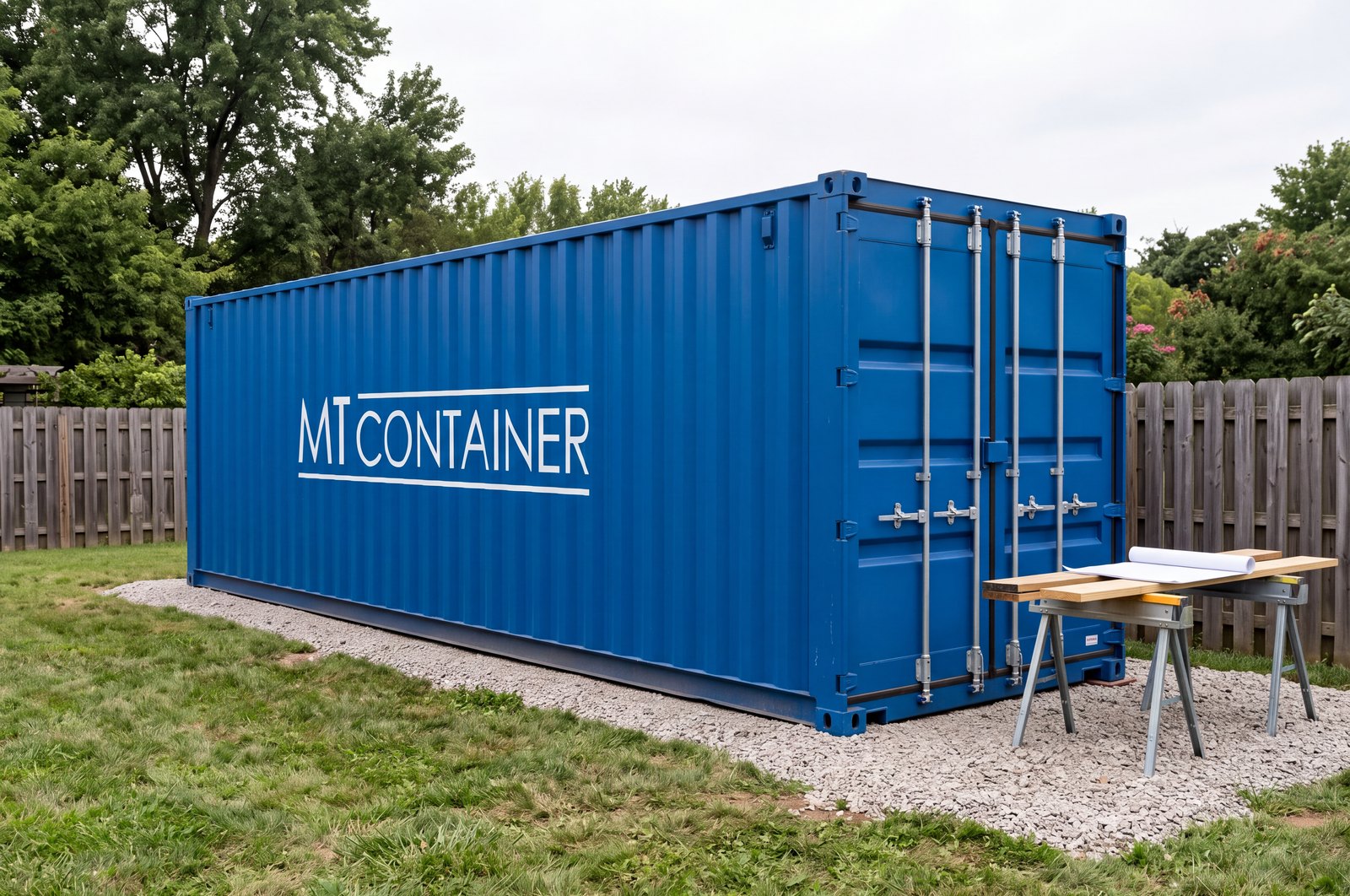
Updated November 2026
Start with the Pool, Then Choose the Container
A shipping container pool needs a water-retaining basin, a supporting structure and pool equipment. For a custom conversion, have the pool designer specify the container before you buy it. MT supplies the container only; your pool builder handles design, conversion and equipment.
Size changes the water load substantially: in our examples below, the 20 ft basin holds about 33,910 lb (15,380 kg) of water and the 40 ft basin about 70,090 lb (31,790 kg). These examples are neither pool designs nor load ratings.
Compare a Finished Pool, a Kit and a Bare Container
| Item | You buy | Check | Next step |
|---|---|---|---|
| Finished pool | A specified pool system | Included equipment and installation scope | Match its drawings to your site |
| Pool kit | The components listed by the seller | Who designs, assembles and tests the whole pool | Resolve missing work before ordering |
| Bare container | The starting cargo container | Designer acceptance of the actual unit | Hire the pool designer and the conversion contractor separately |
A shipping container pool kit needs an itemized parts list and someone responsible for the completed system. Ask whether a liner, an insert or the coated steel itself holds the water. Then ask about its support, seams, repair method and penetrations, meaning the openings for pipes, lights and fittings. The answers help settle who repairs a leak.
Manufacturer example: Modpools.
A finished pool can still leave work with you: one manufacturer states that it does not install its units and requires a licensed general contractor for every installation.
When weighing a shipping container pool vs. a regular pool, compare equal swimming space, equipment and site work. Steps, seating and a spa partition reduce the uninterrupted swimming length.
Check Usable Size and Water Weight
Container interiors, before conversion: these are reference figures, not guaranteed dimensions for an MT offer. High Cube means a taller container; it does not automatically provide a wider pool.
| Item | Length | Width | Height |
|---|---|---|---|
| 20 ft standard | 19 ft 4.3 in (5,900 mm) | 7 ft 8.6 in (2,352 mm) | 7 ft 10.3 in (2,395 mm) |
| 20 ft High Cube | 19 ft 4.2 in (5,898 mm) | 7 ft 8.6 in (2,352 mm) | 8 ft 10.2 in (2,698 mm) |
| 40 ft standard | 39 ft 5.7 in (12,032 mm) | 7 ft 8.6 in (2,352 mm) | 7 ft 10.3 in (2,395 mm) |
| 40 ft High Cube | 39 ft 5.7 in (12,032 mm) | 7 ft 8.5 in (2,350 mm) | 8 ft 10.3 in (2,700 mm) |
Sources: Hapag-Lloyd’s 20 ft, 40 ft and 40 ft High Cube tables; BULLBOX 20 ft High Cube specification. For the 40 ft High Cube, we use the smaller width given in the table; the diagram shows a different figure.
Our space calculation: assume a wall buildup of 3 in (76.2 mm) on each side and end, including support behind the liner or coating. This is a space allowance, not a recommended coating thickness. Subtract twice that allowance from the internal length and width. At an assumed water depth of 4 ft (1.22 m), the examples become:
| Item | Basin length × width | Water volume | Water weight |
|---|---|---|---|
| 20 ft example | 18 ft 10.3 in × 7 ft 2.6 in (5.748 × 2.200 m) | About 4,070 US gallons (15.41 m³, 15,410 liters) | About 33,910 lb (15,380 kg) |
| 20 ft High Cube example | 18 ft 10.2 in × 7 ft 2.6 in (5.746 × 2.200 m) | About 4,070 US gallons (15.41 m³, 15,410 liters) | About 33,900 lb (15,380 kg) |
| 40 ft example | 38 ft 11.7 in × 7 ft 2.6 in (11.880 × 2.200 m) | About 8,420 US gallons (31.86 m³, 31,860 liters) | About 70,090 lb (31,790 kg) |
| 40 ft High Cube example | 38 ft 11.7 in × 7 ft 2.5 in (11.880 × 2.198 m) | About 8,410 US gallons (31.83 m³, 31,830 liters) | About 70,030 lb (31,760 kg) |
These rectangles exclude steps, benches and equipment compartments. Our reading of the figures: the longer shell provides more swimming length, while the taller shell mainly adds vertical space. At 4 ft of water, the standard interior height of 7 ft 10.3 in (2,395 mm) already leaves 3 ft 10.3 in (1,176 mm) above the waterline, before any floor buildup.
Calculate your own basin: multiply length × width × water depth in feet to get cubic feet. Multiply cubic feet by 7.48 for US gallons and by 62.3 for pounds of water. An example with round numbers:
| Item | US | Metric |
|---|---|---|
| Length | 18 ft | 5.49 m |
| Width | 7 ft | 2.13 m |
| Water depth | 4 ft | 1.22 m |
| Volume | 504 cu ft | 14.27 m³ |
| Capacity | About 3,770 US gallons | About 14,270 liters |
| Water weight | About 31,400 lb | About 14,240 kg |
All examples use 62.3 lb per cu ft at about 70°F (21°C), from the USGS density table; water temperature changes the density slightly.
Our arithmetic: 4 ft of water alone weighs about 249 lb on each sq ft of basin floor (1,217 kg per m²). The engineer must add structure, equipment, occupants and other loads, then determine the support reactions—the forces at each support—and design the foundations. These figures establish neither a safe cargo load for the container nor its structural suitability for a pool.
Match the Structure and Water Barrier
We would ask the engineer to review the shell, roof removal, openings, reinforcement and supports together, including the water pressure on the walls.
The water barrier is what holds the water. Document its material, compatibility with pool chemicals, leak test and warranty. For a shipping container pool with a window, include the frame, seals and replacement access. Record who pays for access, removal and restoration during repairs. Separate the component warranties.
Plan the Site, Permits and Delivery
Start with a dimensioned site sketch. Show the property lines, the house, utilities, driveway, pool, equipment access and drainage. Check approvals with your local building and zoning offices, because requirements depend on the installation and location; check homeowners association restrictions separately.
The San Diego pool bulletin requires construction plans, specifications and structural calculations for custom pool submittals. This is a local example, not a US-wide rule.
For an in-ground pool, the designer must address ground pressure, groundwater, drainage and access to buried components. Keep the equipment accessible after decking and landscaping. Before delivery, agree on the truck route, turning space, overhead clearance, unloading method and lifting responsibility; these depend on the site and the vehicle.
Include Barriers and Electrical Safety
The CPSC recommends barriers at least 48 in (1,219 mm) high and outward-opening pedestrian gates that close and latch themselves, including for above-ground pools. Confirm your local barrier, gate, ladder and cover requirements.
Use a qualified pool electrician to document grounding, bonding and ground-fault circuit-interrupter (GFCI) protection. Ask the electrician to explain each measure for your pool. A GFCI interrupts power when it detects current leakage. Our checklist: include pumps, lights, heaters and the metal structure. Sources: CPSC GFCI explanation and pool electrical precautions.
Compare Complete Costs and Ongoing Care
Shipping container pool cost includes the pool or shell, design, permits, foundations, delivery, lifting, utilities, equipment, barriers, decking, taxes and commissioning—the checks on the installed system before handover. Compare itemized quotes and exclusions.
Heating estimates depend on your climate, season, water temperature and utility rates. Include pumping, treatment, cleaning, repairs and replacement parts. The EPA explains that covers reduce evaporation and retain heat; a cover’s safety function needs separate confirmation.
CDC guidance calls for testing and adjustment of the chlorine level and pH, the measure of acidity. Obtain the manufacturer’s winterization and power-outage instructions, plus written confirmation of saltwater compatibility, because materials and equipment differ. Follow the manufacturer’s instructions for inspecting exposed steel and repairing the coating.
Inspect the Starting Container
Have the designer inspect the actual unit’s dimensions, floor, frame, roof and underside. Review photos, previous use, repairs, corrosion, residues and odors.
“New” or “one trip” generally means one cargo journey. “Cargo worthy” concerns cargo transport; “wind and water tight” concerns wind and rain. “As is” means accepting the unit in its current condition, potentially including defects. None of these terms establishes suitability for a pool.
Before You Commit
- Scope: finished pool, documented kit or starting container.
- Space: finished water dimensions, entry and equipment access.
- Engineering: filled loads, supports and installation type.
- Approvals: permits, barriers, electrical work and inspections.
- Handover: complete costs, test records, maintenance and warranty responsibilities.
Ask MT About the Starting Container
MT Container has been trading containers from Hamburg, Germany, since 2008. For a heating-plant project in southern Germany, MT supplied the containers; a local heating contractor handled the technical build-out. That is container supply experience, not pool-building experience.
We source new (one trip) and used 20 ft and 40 ft containers through our US partner network, subject to availability, with US pickup or delivery and offers in USD. You can request both standard and High Cube versions. Delivery is by container truck; unloading is agreed for your location. The partner states the unit’s condition class in writing. Our team responds in English.
Ask about a container for your pool project and send us your ZIP code, quantity, designer’s container specification and site-access details.
Shipping Container Pool Questions
Where Can You Buy a Shipping Container Pool?
A pool manufacturer or specialist installer supplies the finished pool. MT supplies the starting container for a separately designed conversion.
How Do You Make a Shipping Container Pool?
A coordinated design comes first: structure, water containment, utilities and safety. For a DIY shipping container pool or kit, assign responsibility for design, assembly and testing before you buy.
How Long Does a Shipping Container Pool Last?
There is no universal lifespan, because structure, water barrier, installation and care all differ. One manufacturer notes that small, isolated rust spots or discoloration can appear over time, so plan for coating repairs. This example comes from Modpools. Compare component warranties and repair access; warranty coverage does not predict useful life.
Are Shipping Container Pools Cheaper?
Not automatically. The container is only one part of the total. Compare equivalent finished swimming space, equipment and site work.
Can a Shipping Container Pool Be Installed In-Ground?
Yes, if the specific system and the engineered site design support it. Obtain the manufacturer’s approval before excavation.
Sources and Calculation Notes
Sources checked on November 20, 2026. The examples are calculations, not construction designs. We calculate with unrounded dimensions: 25.4 mm per inch, 2.20462 lb per kg and 3.7854 liters per US gallon. Basin dimensions and volumes are rounded; gallons, liters and total water weights use the nearest 10. Area loads and clearance millimeters use whole units.
Manufacturer example, Modpools help center: Modpools installation, Modpools steel care, Modpools saltwater and Modpools winterization. Container terms: Container One terms and conditions and Conexwest condition guide, both read online. None of the companies named on this page is an MT partner, and none of these references establishes an MT pool offering.