
Shipping Container Garages: Access, Space and Planning
Check the vehicle, the doorway and the space to get out before choosing a container. Use two worked examples, a Ford Mustang and a Ford F-150, and a practical checklist to plan your next step.
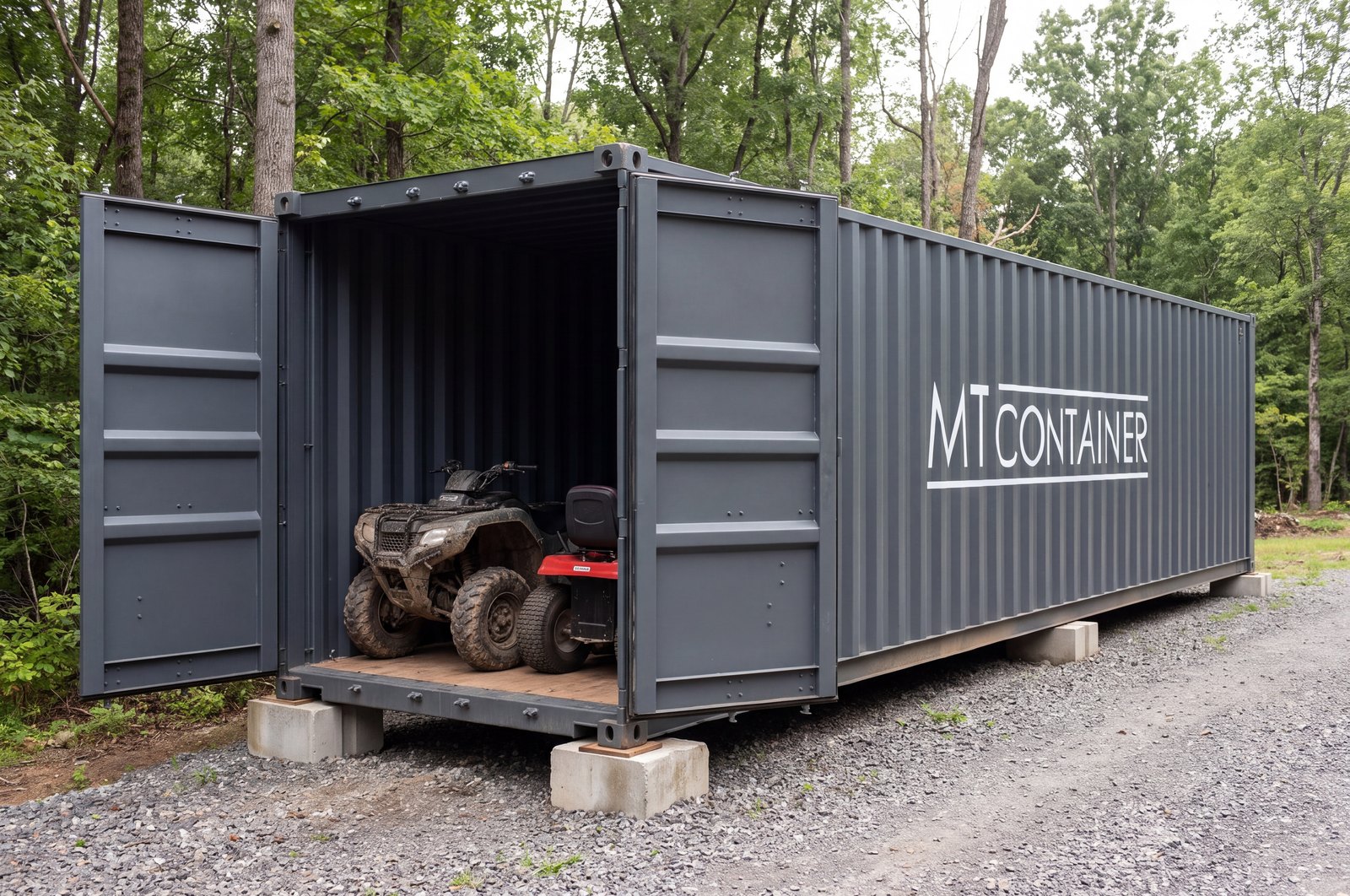
Updated November 2026 · Planning guide for US buyers
Can a Shipping Container Work as a Garage?
A shipping container garage can work for vehicle storage if the vehicle clears the entrance and you can get out of the car, walk out and close the doors behind you. Start with width and access. A longer container gives you space ahead of or behind the vehicle; side access depends on the usable width.
Next, decide how you will use the space. Occasional storage, daily parking and vehicle repair each need a different layout. If you want to open both car doors comfortably or work alongside the vehicle, compare a wider purpose-built garage with a container conversion before buying the shell.
- Vehicle storage: check the entrance, parking position, driver exit and retrieval route.
- Daily parking: test the whole routine, including opening the container doors in bad weather.
- Garage with a work area: draw the bench, tools and walking route with the vehicle parked.
Will Your Car Fit Through the Doors?
Work from the clear opening. Measure the vehicle including its mirrors in the position you will actually use, roof accessories and anything else that projects beyond the body. Measure the approach as well: check the turning route from your driveway into the doorway.
As a dimensional example, Hapag-Lloyd lists the doorway of its standard 20 ft container at 92.1 in wide by 90.2 in high (7 ft 8.1 in by 7 ft 6.2 in; 2,340 by 2,292 mm). Use this fleet example for comparison, then confirm the dimensions of the actual unit. Source: Hapag-Lloyd reference dimensions.
Ford lists the 2025 Mustang EcoBoost fastback at 189.4 in long, 75.4 in wide without mirrors, 81.9 in including mirrors and 55 in high. Source: Ford technical specifications. This worked comparison gives you a starting point for checking your own vehicle.
With that vehicle centered in the reference doorway, the calculated gap is only 5.1 in on each side of the mirrors. This is static clearance; steering, approach angle and the vehicle’s position on a ramp use additional space. Measure the actual unit before ordering.
Fitting Inside Is Different from Getting Out
The same reference container is 232.3 in long (19 ft 4.3 in) and 92.6 in wide (7 ft 8.6 in) inside (5,900 and 2,352 mm). Subtract the Mustang’s body width and divide the remainder equally: only 8.6 in per side remains beside the body. Subtract its length, and 42.9 in total is left ahead of and behind it. These are our calculations from the sources above, rounded after calculation.
Put differently, the body leaves 17.2 in of spare width in total. Measure how far your driver’s door must open before you can step out, and compare the two figures. Parking off-center gives the driver’s side more room. The full 17.2 in stays out of reach while the passenger-side mirror is extended, because the mirrors make the car 81.9 in wide: with both mirrors extended, only 10.7 in of spare width is left in total (our calculation). The drawings show the vehicle envelope; test the car-door swing separately. If your door needs more room than that test leaves, a single container does not work as a drive-in garage for that vehicle.
Before committing, mark the proposed inner walls and doorway on open ground. Position your vehicle within those marks, then test the driver’s door, the trunk or tailgate, and your route past the vehicle. Include the interior paneling, shelves, door tracks and equipment.
Write down the smallest usable clearance instead of relying on a floor-area figure. If you plan a separate pedestrian door, you still need enough space to open the car door and reach that exit.
Choosing Length, Height and Door Arrangement
Once the access test works, consider a 20 ft container for vehicle storage. A 40 ft container can provide a separate area beyond the parked vehicle. Hapag-Lloyd’s standard reference is 473.7 in long inside (39 ft 5.7 in; 12,032 mm), with the same listed interior and door widths as its standard 20 ft reference. Source: Hapag-Lloyd 40 ft reference.
| Reference | Length | Width | Height | Door opening | Remaining length |
|---|---|---|---|---|---|
| 20 ft standard (reference): | Inside length: 232.3 in (19 ft 4.3 in); | Inside width: 92.6 in; | Inside height: 94.3 in; | Door opening: 92.1 in wide by 90.2 in high; | Length left with the example Mustang: 42.9 in |
| 40 ft standard (reference): | Inside length: 473.7 in (39 ft 5.7 in); | Inside width: 92.6 in; | Inside height: 94.3 in; | Door opening: 92.1 in wide by 90.2 in high; | Length left with the example Mustang: 284.3 in (23 ft 8.3 in) |
The two example vehicles against the same references:
| Vehicle | Length | Width without mirrors | Width with mirrors | Height | Doorway width to spare | Length left: 20 ft | Length left: 40 ft |
|---|---|---|---|---|---|---|---|
| 2025 Ford Mustang EcoBoost fastback: | Length: 189.4 in (15 ft 9.4 in); | Width without mirrors: 75.4 in; | Width with mirrors: 81.9 in; | Height: 55 in; | Doorway width to spare with mirrors extended: 10.2 in (both sides combined); | Length left in the 20 ft reference: 42.9 in; | Length left in the 40 ft reference: 284.3 in (23 ft 8.3 in) |
| 2027 Ford F-150 SuperCrew (5.5 ft box, 4×4): | Length: 232.0 in (19 ft 4.0 in); | Width without mirrors: 79.9 in; | Width with mirrors: 95.7 in (standard mirrors); | Height: 77.1 in (cab, empty); | Doorway width to spare with mirrors extended: none (3.6 in too wide); | Length left in the 20 ft reference: 0.3 in; | Length left in the 40 ft reference: 241.7 in (20 ft 1.7 in) |
Pickup dimensions: Ford specifications, page 6. Both vehicle rows use the same container references; the spare widths and remaining lengths are our calculations.
A high cube adds about 12 in of height. Hapag-Lloyd lists 94.3 in of interior height (2,395 mm) for its standard 20 ft and 40 ft containers. For its 40 ft high cube it lists 106.3 in of interior height (2,700 mm) and 102.2 in of door height (2,597 mm), against 90.2 in for the standard door. The Mustang is 55 in high and the F-150 cab is 77.1 in high, so both clear the 90.2 in reference door height on paper; width is the limit for both. For a tall SUV, van or truck, compare the vehicle height including roof racks with the door height first. Source: Hapag-Lloyd high cube reference. Treat headroom and side clearance as separate checks. Measure the actual clear door height and the space lost to any roll-up mechanism, ceiling paneling or lights. A vehicle lift needs a project-specific check of headroom, floor capacity and support.
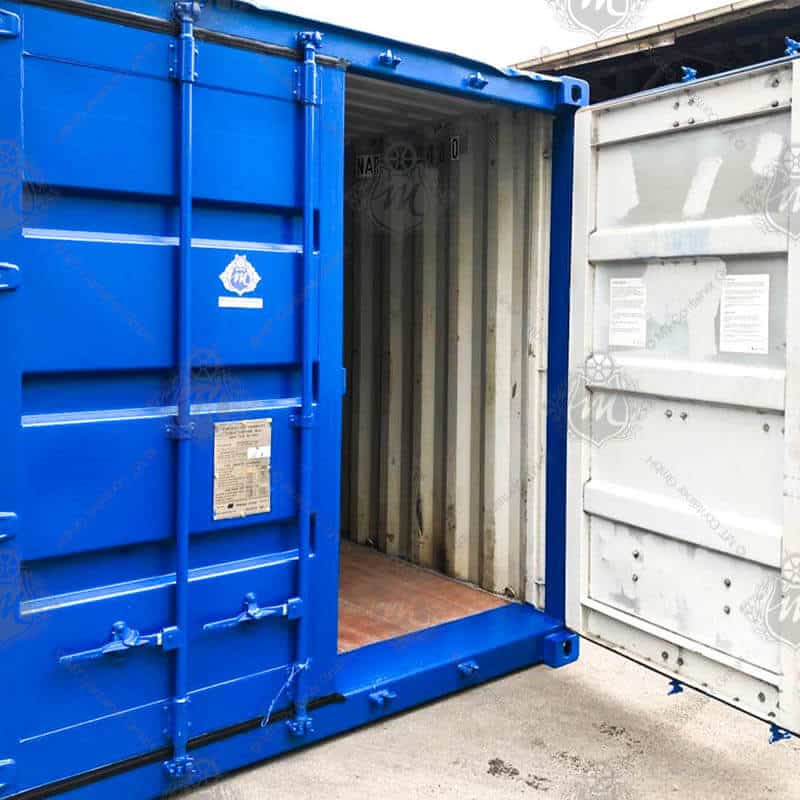
- Original cargo doors: confirm the full swing and how both door panels will be held open. Keep the approach and pedestrian route clear.
- Doors at both ends: useful for access from either end where the site allows it. The enclosed width stays the same.
- Open side: may help you reach a parked vehicle from outside. Check where the side doors open and whether that access remains usable on your site. The enclosed parking width stays the same.
- Roll-up or sectional door: ask for the finished clear opening, threshold, headroom and frame details. The door’s advertised size may differ from the usable opening after installation.
- Locking: decide how the doors will be locked and whether the lock is shielded. Ask which locking hardware the unit has; do not assume a lock box is fitted.
Wider Garages and Roofs Between Containers
For side-by-side parking, compare a purpose-built garage, a roofed bay between containers and a design that joins containers into a wider room. In a roofed-bay layout, vehicles park in the gap; the containers can remain separate storage units. A roof alone creates covered parking, like a carport, not a fully enclosed garage.
Joining containers by removing walls changes the structure. Have a qualified local design professional assess openings, reinforcement, connections and foundations before any cutting. A roof spanning between boxes also needs its own load and attachment design. A container’s shipping and stacking ratings describe transport use. The altered building needs its own design assessment.
San Diego’s cargo-container bulletin illustrates this distinction: it addresses altered and connected containers and sets out when drawings, calculations and reports are needed. Its local provisions are not a construction recipe for other places. Source: San Diego cargo-container requirements.
Check the Site Before Ordering
Permission for the intended use
Ask your building and zoning offices about vehicle storage at your exact property, with the proposed doors, utilities and layout. Include any homeowners association (HOA) restrictions. Describe the intended vehicle use clearly so the answer covers your project.
Portland’s simplified review path for storage containers applies only where containers are not used to store motorized passenger vehicles. A garage falls outside that path and under the regular building requirements. Use this local example to frame the questions for your own authority. Source: Portland Building Code Guide.
Ground, floor and ramp
Have the site assessed for support, drainage and anchoring. Give the designer the container’s condition, the vehicle loads and the proposed alterations, and ask for a foundation and support plan for that combination. Include the ground or existing slab in that assessment, even where the driveway looks level.
Check the floor and supporting structure of a used unit. Ask specifically about wheel loads and any proposed jacks, stands or lift. Check concentrated wheel and equipment loads separately from overall payload. Specify a suitable vehicle ramp, its load rating, attachment and transitions; check ground clearance at the approach and at the threshold. The right ramp length depends on your vehicle’s ground clearance and the height of the container floor above the ground.
Truck access and placement
US delivery is by container truck through the partner network. Confirm the unloading method for your location with our team. Provide the delivery ZIP code, photos of the entrance and driveway, overhead obstacles, turning space and a sketch of the final door orientation. Arrange firm, level ground and enough unloading space for the confirmed vehicle and method. Have the quote identify the unloading equipment and who provides it.
Plan for Moisture and Keep Exhaust Outside
Even in a weather-tight shell, cold steel surfaces can collect condensation. Wet vehicles and damp equipment bring moisture in. Plan drainage, air movement and any insulation or dehumidification together. Show the usable width after paneling in your drawing, and inspect for leaks before concealing the steel.
EPA guidance identifies moisture reduction, air movement and insulation of cold surfaces as ways to address condensation. Match the arrangement to your climate, moisture sources and use. Source: EPA moisture guidance.
Do not idle or warm up a vehicle inside the container. Carbon monoxide can accumulate even with the door open. Keep engine-running work outside; plan electrical equipment and any charging installation with a qualified electrician. Source for the exhaust warning: EPA carbon monoxide guidance.
Buying the Container and Comparing Project Costs
Compare complete project scopes for a container conversion and a purpose-built garage. Ask for separate line items for the shell, delivery and unloading, site work, design and permits, doors and reinforcement, ramp, moisture control and electrical work. Include taxes and any work needed to make a used unit suitable. Use those totals to decide which option suits your budget.
Ask for recent photographs, the unit’s dimensions and a description of its condition. Check the roof, door seals, hinges, locking bars, floor and underside, and look for evidence of repairs. Ask about previous use and any unresolved odors or residues. Ask for repair records as well as photographs of the finish.
US sellers use the following terms, but their conditions and warranties differ:
- New / one trip: a container sold after its initial loaded journey; handling marks can still occur.
- Cargo worthy: a description related to fitness for cargo transport. Ask what inspection and documentation support it.
- Wind and water tight: a storage-condition description concerning weather entry; it is not the same as transport approval.
- As is: establish defects, repairs and written terms before comparing the offer.
These explanations draw on the seller references listed below. Confirm the condition and written terms for your specific unit, and arrange a separate assessment for the garage conversion.
Seven Checks Before You Order
1. Measure your vehicle with mirrors, racks and accessories.
2. Compare it with the clear door opening of the actual unit.
3. Mark the inside width on open ground and test the driver’s door.
4. Ask your building and zoning offices about vehicle storage at your address.
5. Have the ground, the floor loads and the ramp assessed.
6. Confirm truck access and the unloading method.
7. Get the unit’s condition and the terms in writing.
Ask About a Container for Your Garage Project
MT Container has traded containers from Hamburg, Germany, since 2008. In a heating-plant project in southern Germany, our role was to supply the containers; a local heating contractor carried out the technical build-out. On a construction site in Hamburg, one 10 ft and three 20 ft containers served as lockable storage for tools and materials, starting in 2024. These German projects illustrate container supply and storage use; the vehicle examples in this guide are calculations.
For US buyers, new (one trip) and used 20 ft and 40 ft containers, including high cube versions, are sourced through our US partner network, subject to availability. Double-door and open-side options are also subject to availability. Pickup or delivery in the US is arranged for the agreed unit; offers are priced in USD. The partner states the unit’s condition class in writing. Our team responds in English.
Send us your ZIP code, intended use, vehicle measurements including mirrors, preferred door arrangement and site-access details. Ask about the starting container and any project-specific requirements. MT supplies the container. A finished garage, its engineering and the local construction work are not part of that supply; arrange them with local professionals.
Common Questions About Container Garages
Will a car fit in a 20 ft shipping container?
The 2025 Ford Mustang in our example fits a standard 20 ft reference container on paper: 42.9 in of length remains, but only 8.6 in beside the body on each side. Width, not length, is the limit. Test your own vehicle with the marking trial above.
Is a 40 ft container better for a garage than a 20 ft?
It adds length, not width. With the Mustang from our example, 284.3 in (23 ft 8.3 in) of length remains for storage or a bench. The room to open a car door stays the same.
Do I need a permit for a shipping container garage?
That depends on your address. Ask your building and zoning offices about vehicle storage specifically. The San Diego and Portland examples above show that local rules differ.
Can I run the engine inside if the doors are open?
No. The EPA warns that carbon monoxide can build up to deadly levels even with a garage door open.
How much does a shipping container garage cost?
The container is only one part of the total. Add delivery and unloading, site work, design and permits, doors and reinforcement, a ramp, moisture control and electrical work. Ask for each as a separate line item. Then compare the total with a quote for a purpose-built garage.
Will a pickup truck or SUV fit in a shipping container?
Check the width first. Compare your vehicle’s width including mirrors with the 92.1 in reference doorway. Then compare its height including racks with the 90.2 in standard door or the 102.2 in door of the 40 ft high cube reference. Measure with the mirrors folded and extended.
The 2027 Ford F-150 SuperCrew (5.5 ft box, 4×4) is 232.0 in long, 79.9 in wide without mirrors, 95.7 in with standard mirrors and 77.1 in high with the cab empty. Its extended mirrors exceed the reference doorway by a total of 3.6 in. In the 20 ft reference, only 0.3 in of length is left; in the 40 ft reference, 241.7 in (20 ft 1.7 in) is left. So this truck does not pass the reference doorway with its standard mirrors extended, and a 20 ft container is too short for it in practice. Inside, the body would leave only 6.3 in per side, so check first whether you could get out at all. These are our static calculations from the reference dimensions. Folding the mirrors requires a separate measurement; body width alone does not establish folded-mirror clearance. Source: Ford specifications, page 6.
Sources and Reference Limits
Technical and regulatory sources checked on November 26, 2026. Inches and clearances are our own conversions and calculations using 25.4 mm per inch, rounded to 0.1 in after calculation. Container references vary by manufacturer. Vehicle dimensions refer only to the Ford models identified above; actual accessories and modifications must be measured.
- Hapag-Lloyd standard-container pages and Ford specifications, linked beside the dimensional example.
- Local guidance from San Diego and Portland, linked beside the relevant planning questions. Confirm the rules adopted at your site.
- EPA guidance, linked in the moisture and exhaust section.
- Container One: condition descriptions.
- Conexwest: condition terminology. Both seller pages are cited only to explain common terms. Seller-specific service and warranty claims are not transferred to MT.