
CSC Plates: What to Read and What to Ask For
Read the approval fields, check the examination route and request the records for the container you plan to buy.
Sources checked November 26, 2026 · Container buying guide
What Is a CSC Plate?
A CSC plate is a shipping container’s safety approval plate under the International Convention for Safe Containers. It shows the approval, the date of manufacture and the structural ratings. Before buying a container for international transport, read the plate, establish the current examination status and match the paperwork to the container on offer.
Under periodic examination, a container approved as new has its first examination due within 5 years of manufacture; after that, the intervals are 30 months at most. The alternative is an approved continuous examination program. The plate and the current inspection evidence answer two different questions: how the container was approved, and how it is being maintained. Sources: the International Maritime Organization (IMO) and US container examination rules.
CSC Plate Location, Dimensions and Fields
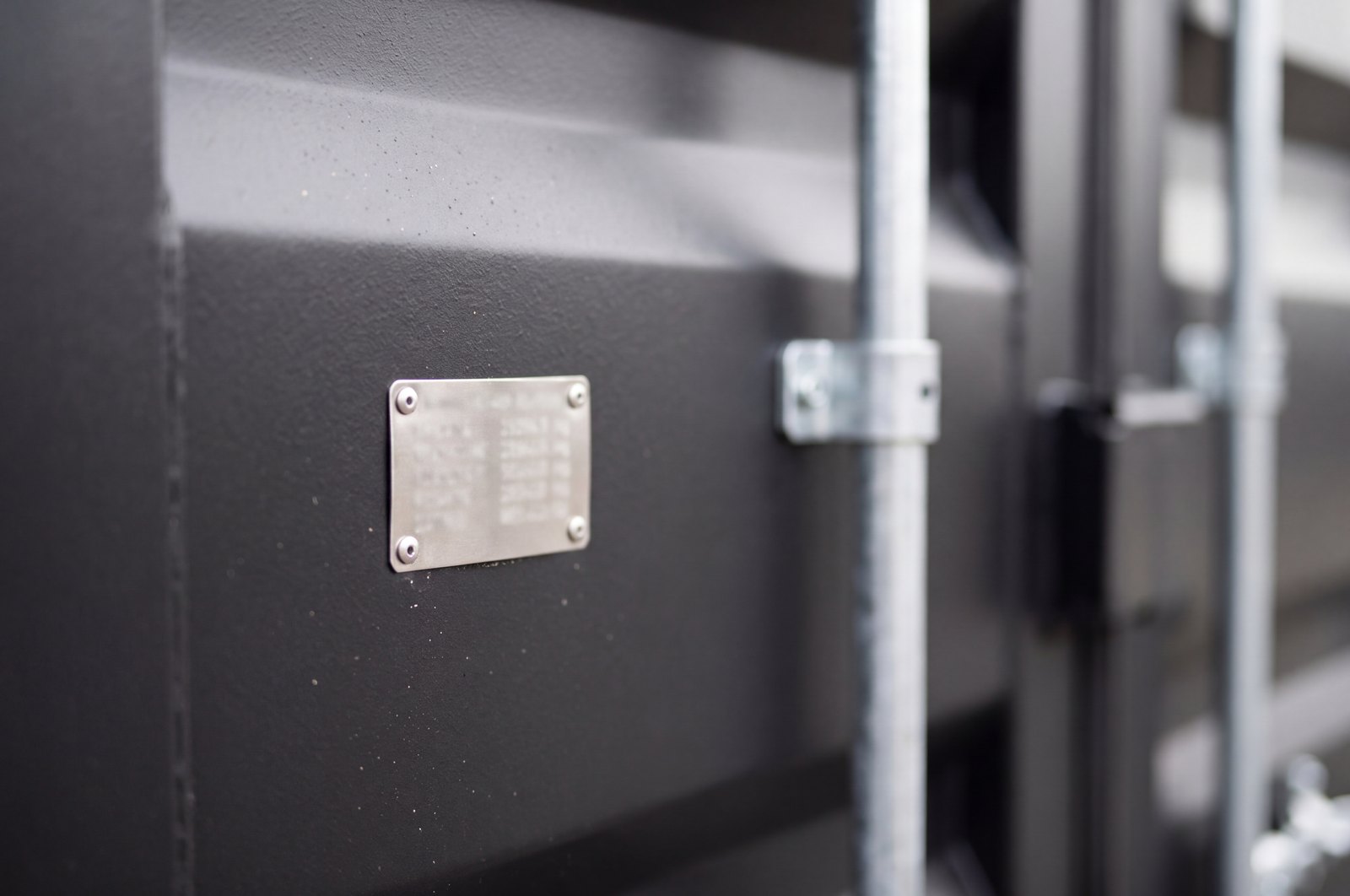
Start at the door end. BIC, the organization behind the Global ACEP Database, describes the plate as typically riveted to the outside of the left door. It can be part of a larger combined data plate that also carries other information. Ask for a sharp close-up plus a wider photo showing the plate’s position on the unit on offer.
A CSC plate measures at least about 7.9 by 3.9 in (200 by 100 mm). The metric dimensions define the minimum; the inches are our rounded conversion. The drawing below the table leaves values blank for the actual container’s data.
| Field | Meaning | Ask for |
|---|---|---|
| Approval reference | country of approval and approval reference | a readable reference and supporting approval details if unclear. |
| Date manufactured | the month and year the container was built | confirmation that the advertised build date matches. |
| Identification | manufacturer identification or an accepted alternative | records linking this identity to the container offered. |
| Maximum operating gross mass | the container and its cargo together, shown in kilograms and pounds | the actual rating and the unit’s tare weight. |
| Allowable stacking load for 1.8 g | the designed maximum static load from the containers stacked on top, in kilograms and pounds | the rating for the intended stacking arrangement. |
| Transverse racking test force | the test force that racks the container’s end structures sideways, in newtons | the value with its original unit. |
| Examination marking | a next examination date or approved program reference | current examination evidence and the responsible owner or operator. |
The field layout follows the CSC specifications in the UK regulations, Schedule. US rules allow an owner’s identification number in place of the manufacturer’s, with corresponding records. Additional wall-strength or one-door-off ratings can appear where applicable. Ask for the ratings that cover the intended configuration.
Read the Load Ratings Correctly
Maximum gross mass includes the container itself. Tare is the container’s empty mass, including permanently fitted equipment. Maximum payload is gross rating minus tare. The tare is not one of the plate fields listed above; ask the seller for it before calculating a cargo allowance.
The label 1.8 g belongs to the field name; the value itself is the designed maximum static load from above. g denotes the standard acceleration of gravity. Go by the rating stated on the plate and ask the operator to confirm the proposed stack. Racking describes sideways distortion of the container’s end structures. Read its unit carefully: the CSC format specifies the force in newtons; if a plate or record shows another unit, keep that unit as written. The Schedule and the Indian Register guidance explain these fields.
CSC Plate Validity: Periodic Examination or ACEP?
PES stands for Periodic Examination Scheme. Under US rules, examinations follow at intervals of 30 months or less. For a container approved as new, the first examination falls within 5 years of manufacture. The NED, or Next Examination Date, gives the month and year before which the next examination is required. Look for it on the plate or as close to it as practicable. It is a due date, not the date of the last inspection.
ACEP stands for Approved Continuous Examination Program. Look for its reference near the plate. US rules require thorough examinations at major repair, at refurbishment and at on-hire/off-hire interchange, with a maximum interval of 30 months. On-hire and off-hire mean the handover of a container at the start and at the end of a lease. ACEP replaces the periodic date-marking route; it still requires examinations and records.
After a purchase, you as the new owner are responsible for maintenance and examination. Establish which examination arrangement will cover the container after handover. Ask for its latest examination record, the examiner’s identity and the party responsible for continued maintenance. BIC’s Global ACEP Database helps identify approved programs; a program listing alone does not establish that the particular unit remains covered.
What to Ask Before You Buy
The first three points are requests to the seller; copy them into your inquiry when comparing offers. The fourth is your own step. Our checklist draws on plate fields, US recordkeeping requirements and Container Owners Association (COA) guidance for shipper-owned containers – containers that the shipper supplies for a carrier to transport.
- Identify the unit: send the container number, readable plate photos and records explaining any different manufacturer number.
- Confirm examination: state PES or ACEP, provide the applicable date or program reference, and supply the latest examination record.
- Describe condition: disclose cracks, corrosion, missing or deteriorated fasteners, structural repairs and alterations; explain how safety-related defects were resolved.
- Confirm the journey yourself: submit the unit details to the shipping line or to the freight forwarder (the company arranging the shipment) and establish its acceptance requirements.
For altered containers or missing approval data, contact the relevant authorized inspection body about reassessment. For every examination, US rules require personnel trained and experienced in detecting structural damage.
Ask MT About the Offered Container
MT Container has been trading containers from Hamburg, Germany, since 2008. New (one trip) and used standard containers for US customers are sourced through our US partner network, subject to availability. The partner states the condition grade for each unit. Quotes are in USD. Our team responds in English.
Send us your destination ZIP code, intended use and preferred container type. Ask for the offered unit’s current CSC status and the available examination evidence. MT’s role here is container sourcing; CSC inspection or certification is not part of this offer.
Questions About CSC Plates
How do you check CSC plate validity?
Find the examination marking at or near the plate: a next examination date (month and year) or an ACEP reference. A date that has passed means the examination is overdue. Then match the unit identity and approval details, obtain the examination evidence and confirm acceptance for the intended journey.
How long is a CSC plate valid for?
Validity depends on the examination status, not on the plate alone. Under periodic examination, US rules set intervals of 30 months at most; for a container approved as new, the first examination is due within 5 years of manufacture. Under ACEP, thorough examinations follow the approved program, with no more than 30 months between them. Current condition still matters within those intervals.
Who issues a CSC plate?
The approval comes from a contracting state’s administration or its authorized organization. The manufacturer is authorized to affix the plate to an approved container, as IMO explains.
How do you get a CSC plate for a container?
Start with the unit’s approval records and the relevant approval or inspection body. Missing approval data or a modified container may require reassessment. A blank plate on its own carries no approval, because approval comes from the authority or its authorized organization.
Does cargo worthy mean a current CSC examination?
No. Cargo worthy is a condition description. Request the unit’s CSC evidence separately; COA treats structural condition and CSC examination as distinct acceptance checks.
Sources and Scope
This guide explains buying checks. For the actual container, the applicable authority’s rules, the unit’s records and the carrier’s requirements govern.
- Approval: IMO: International Convention for Safe Containers.
- Plate fields: CSC plate specifications, Schedule to the UK 2017 Regulations; Indian Register: Certification of Containers, Annex IV.
- US identification and examination: 49 CFR 451.25 and Part 452, official 2025 edition.
- Location and program lookup: BIC: Combined Data Plate and Global ACEP Database.
- Buying and carrier checks: COA: Cargo-Worthy Shipper Owned Containers, TG03.