
Container Farming: Growing Space, Storage and Cold Storage
Plan a growing space, storage for farm supplies or a cold-storage unit. Start with the job, then specify the container and equipment it needs.
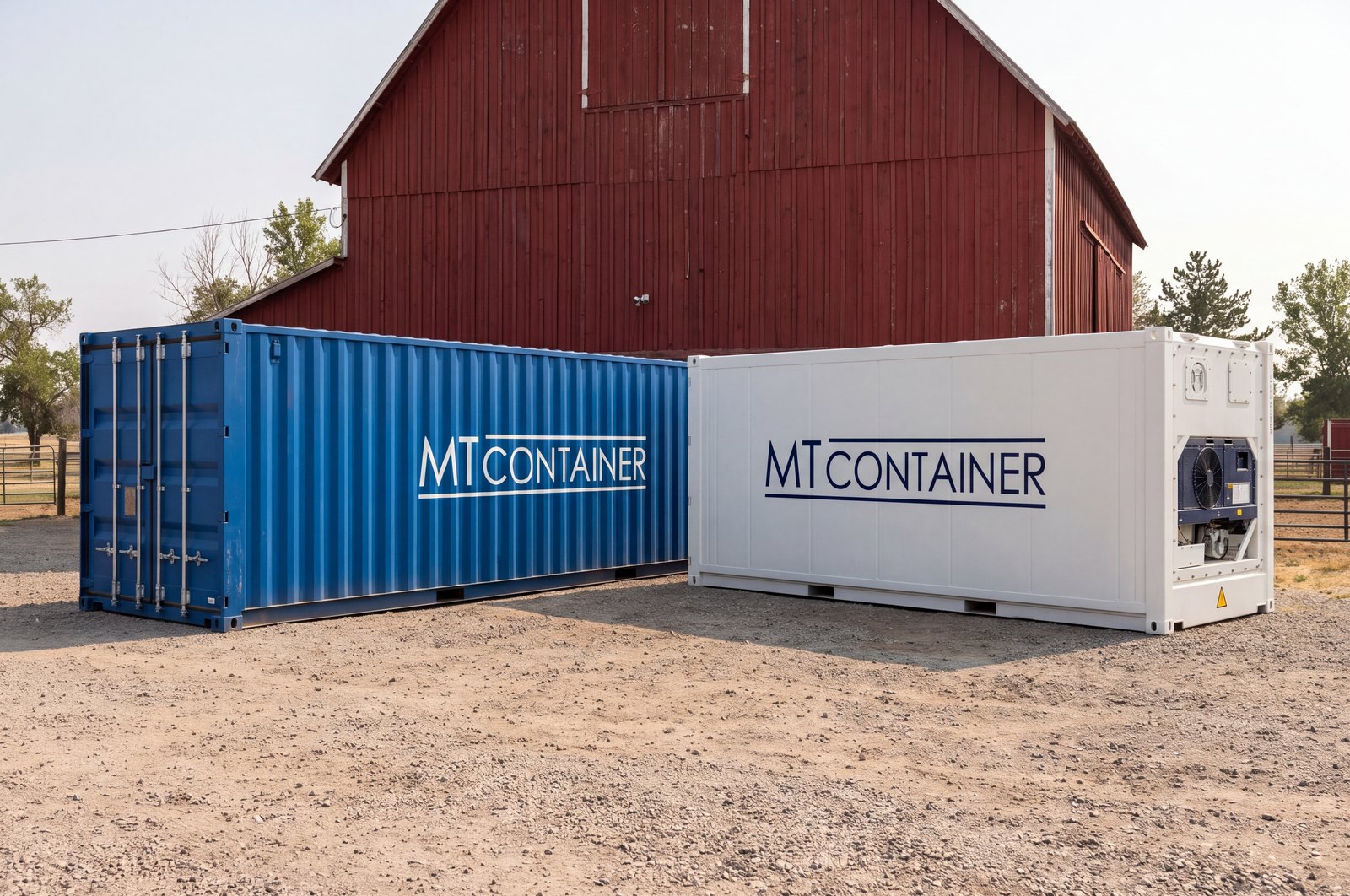
Container farming means growing crops inside an equipped shipping container. Crop production, insulated farm storage and powered cold storage each need a different specification. Use the figures below to compare system requirements before requesting the shell, meaning the container itself.
Planning guide updated November 2026.
Choose Growing Space, Farm Storage or Cold Storage
Choose by the job the container has to do. A growing system manages plants, light and nutrients. An insulated container provides an enclosed storage space. A refrigerated container, also called a reefer, adds powered cooling. Use this comparison to start your requirements.
| Use | Starting point | Main requirement | Ask for |
|---|---|---|---|
| Growing crops | a purpose-designed growing system inside a suitable shell | crop plan, lighting, irrigation and climate management | system layout and utility specifications |
| Seed, feed and equipment | a storage container selected for the goods | product-specific storage conditions and usable access | interior condition, insulation details and door measurements |
| Chilled produce | a working reefer matched to the product | required cooling capacity, power and airflow | machinery details and a loading plan |
Name the activity in your inquiry: growing lettuce, storing packaged feed or holding harvested produce. Separate the container from specialized equipment in the scope.
How Hydroponic Container Farming Works
Hydroponics grows plants without soil, using water to deliver nutrients. Container vertical farming arranges the growing positions vertically within the enclosure. University of Minnesota Extension’s guide distinguishes nutrient film technique (NFT) channels with shallow flowing solution from deep water culture, where roots reach into a reservoir beneath floating supports. The guide also covers ebb-and-flow, one of the methods that use a growing medium.
Start by looking at herbs and leafy greens. University of Minnesota Extension, writing about small-scale systems, names them as good choices for indoor production in winter.
Our planning recommendation: map seeding, transplanting, harvesting and cleaning around the crop racks. Commissioning means testing and starting the complete installation; assign responsibility before ordering.
- 1. Crop positions and lighting
- 2. Working access
- 3. Nutrient-system equipment
Growing Area, Light, Water and Electricity
A City of Boston planning guide shows a typical freight container measuring 40 ft × 8 ft (12.19 × 2.44 m). Multiplying those dimensions gives 320 sq ft (29.7 sq m). This is the exterior footprint, not usable growing area. Metric figures here are our conversions.
A commercial system example: the manufacturer’s May 2023 product booklet for the Greenery S lists 220 sq ft (20.4 sq m) of growing space in its cultivation area. That describes a production zone, not the sum of vertical leaf surfaces or an industry average. Its water figure is an average 5 US gal/day (18.9 L/day). Confirm whether filling, cleaning and solution changes are included in your project’s water allowance.
The same system’s manufacturer FAQ reports 151–246 kWh/day in Eco mode, 171–268 kWh/day in Standard mode and 191–350 kWh/day in Performance mode. Our calculation: across the three modes, that is about 4,530–10,500 kWh over 30 days. Show that range to your electric utility before you plan the site. Consumption varies with crop, humidity and outside climate. Daily energy use differs from the electrical connection rating. These are manufacturer figures for an equipped farm, not MT measurements or a forecast for an empty container.
Light is a crop requirement: Virginia Cooperative Extension lists a target daily light integral (DLI), the photosynthetic light received per day, of 12–17 mol/m²/day for lettuce. DLI uses scientific units rather than floor-area units. Check light at the crop canopy; this general crop reference is separate from the manufacturer’s electricity figures.
For the NFT channels described above, University of Tennessee Extension gives a slope of 1–2%; our conversion is 0.12–0.24 in per foot (10–20 mm per meter).
Our calculation for a hypothetical 10 ft (3.048 m) horizontal channel run gives a fall of 1.2–2.4 in (30.5–61.0 mm). This shows why a layout needs side-view drawings with heights (elevations) as well as a floor plan. This example concerns an NFT channel, not the container foundation or the cited commercial system’s drip irrigation.
Write the Utility and Operating Requirements
UConn Extension’s guidance on container projects calls for advance planning of permits, foundations, electricity and water. It also highlights temperature, humidity, light, water quality, nutrient management and pests as operating topics.
Request written answers:
- Electricity: list the connection requirements and loads for lighting, pumps and climate equipment. Ask for measured consumption from a comparable installation and the conditions behind it.
- Water: provide a water-quality report and ask the system supplier to specify treatment, filling, drainage and disposal arrangements.
- People: identify the operator, the training, the cleaning schedule and the response to equipment faults.
- Scope: separate the shell, growing equipment, installation, commissioning, consumables and ongoing support in the quote.
Keep these requirements with your layout and supplier quote. Mark what is included and what needs a separate supplier.
Farm Storage for Seed, Feed and Equipment
MT’s documented agricultural storage uses include seed, feed and equipment. Our insulated containers are former reefers with the refrigeration machinery removed and the machinery opening closed with an insulated wall. This is MT’s storage experience; crop production is discussed here on the basis of external sources.
Choose the storage conditions to suit the contents. Iowa State Extension advises keeping seeds dry and cool and describes sealed jars for small seed quantities. Follow the seed supplier’s instructions for commercial lots. An insulated shell alone does not establish a controlled temperature.
Alabama Extension’s horse-feed guidance emphasizes dry, covered hay storage and rodent control. Follow the feed manufacturer’s instructions and plan cleaning between deliveries.
For equipment, compare the widest item and its handling clearance with the actual door and interior measurements. Leave access to frequently used items when positioning shelves.
- 1. Insulated closure in the former machinery opening
- 2. Working refrigeration machinery with power connection
Refrigerated Storage Container: A Separate Job
A refrigerated storage container is the option to assess when produce needs powered cooling. MT’s documented reefer applications include agriculture. Give the supplier the crop, its incoming condition, the quantity, the loading pattern and the required storage conditions.
The shipping guidance listed under Sources concerns transport: product temperature before loading and airflow around the load. Ask a refrigeration specialist whether the unit only has to hold produce that is already cold, or also has to remove field heat, the warmth the crop brings in from the field. Agree on power, monitoring and the response to a failure at your site. If the site has no suitable power connection, ask about a generator set (genset); MT also offers gensets for purchase, subject to availability. US gensets are sourced through our US partner network. See our reefer container guide.
Check the Container and Prepare the Site
Treat condition labels as the start of a conversation. In US seller descriptions, “new” or “one trip” refers to an initial freight journey; “cargo worthy” concerns suitability for freight service; “wind and water tight” concerns weather protection; “as is” calls for close attention to the seller’s stated defects and terms. The trade sources for these terms are listed under Sources.
Our suggested inspection: request recent photos of the interior, roof, floor and doors, the known previous use, repair details and a written condition description for the unit offered. For growing or food-related storage, have the system designer or a food-safety specialist assess the interior materials and cleaning arrangements for the intended use.
Send driveway, gate and overhead-clearance photos. Have the transport provider assess the placement and unloading space. Agree on the foundation, utilities and unloading method before delivery, following UConn’s planning approach.
Request a Container for Your US Farm
MT Container has been trading containers from Hamburg, Germany, since 2008. Standard containers, insulated containers and reefers are sourced through our US partner network, subject to availability. Quotes are in USD. Our team responds in English.
Standard containers can be requested in 10 ft, 20 ft, 40 ft, 20 ft high cube and 40 ft high cube sizes, new (one trip) or used, and also as double-door or open-side units, all subject to availability. A high cube is the taller version. Send us your destination ZIP code, intended use, preferred size and condition, the contents and photos of the access. The partner states the condition of the unit offered in writing. Pickup or delivery in the US is available; containers are delivered by container truck, with the unloading method agreed for the site.
MT’s offer here is the container. In a growing project, specify the growing-system supplier separately. Businesses can also discuss shipping container leasing through our US partner network, subject to availability.
Questions About Container Farming
What is container farming?
Container farming is crop production inside an equipped shipping container. Hydroponic equipment, lighting and climate management support growing; agricultural storage serves a separate purpose.
Is container farming profitable?
Not automatically. It depends on what you can sell locally and what the farm costs to run. Before committing, build a budget from verified local demand, achievable salable output and the supplier’s operating data.
What goes into container farming cost?
The project budget should separate the container, growing system, site work, utilities, delivery, training and operation. Compare written quotes against the same scope and ask who is responsible for each item.
Can an insulated container replace a working reefer?
No. MT’s insulated containers have had their refrigeration machinery removed. If you need cooling, request a working reefer and confirm its suitability for the product and site.
Does MT supply a complete container farm?
No. MT supplies the container described in your offer. Growing equipment, crop design and commissioning belong in a separate scope for a specialized supplier.
Sources and Scope
Sources checked November 26, 2026. System figures belong to their authors and need project-specific confirmation. Layout and buying checklists are MT editorial recommendations. No yield or profit is promised.
- Growing: Boston planning guide, footprint example; Minnesota Extension.
- System example: Freight Farms, Greenery S booklet, cultivation space and water; manufacturer FAQ, electricity by mode. Light: Virginia Cooperative Extension, DLI reference.
- Channel slope: Tennessee and Florida Extension. Site planning: UConn Extension, shipping container projects.
- Storage: Iowa State Extension; Alabama Extension; Hapag-Lloyd cargo guidance.
- Condition vocabulary: Western Container Sales; Conexwest. MT statements: confirmed company information.