
Container Chassis: How Containers Travel by Road
Match the chassis to the container, then plan how the box will reach the ground at its destination.
Updated November 2026 · Container transport basics
What Is a Container Chassis?
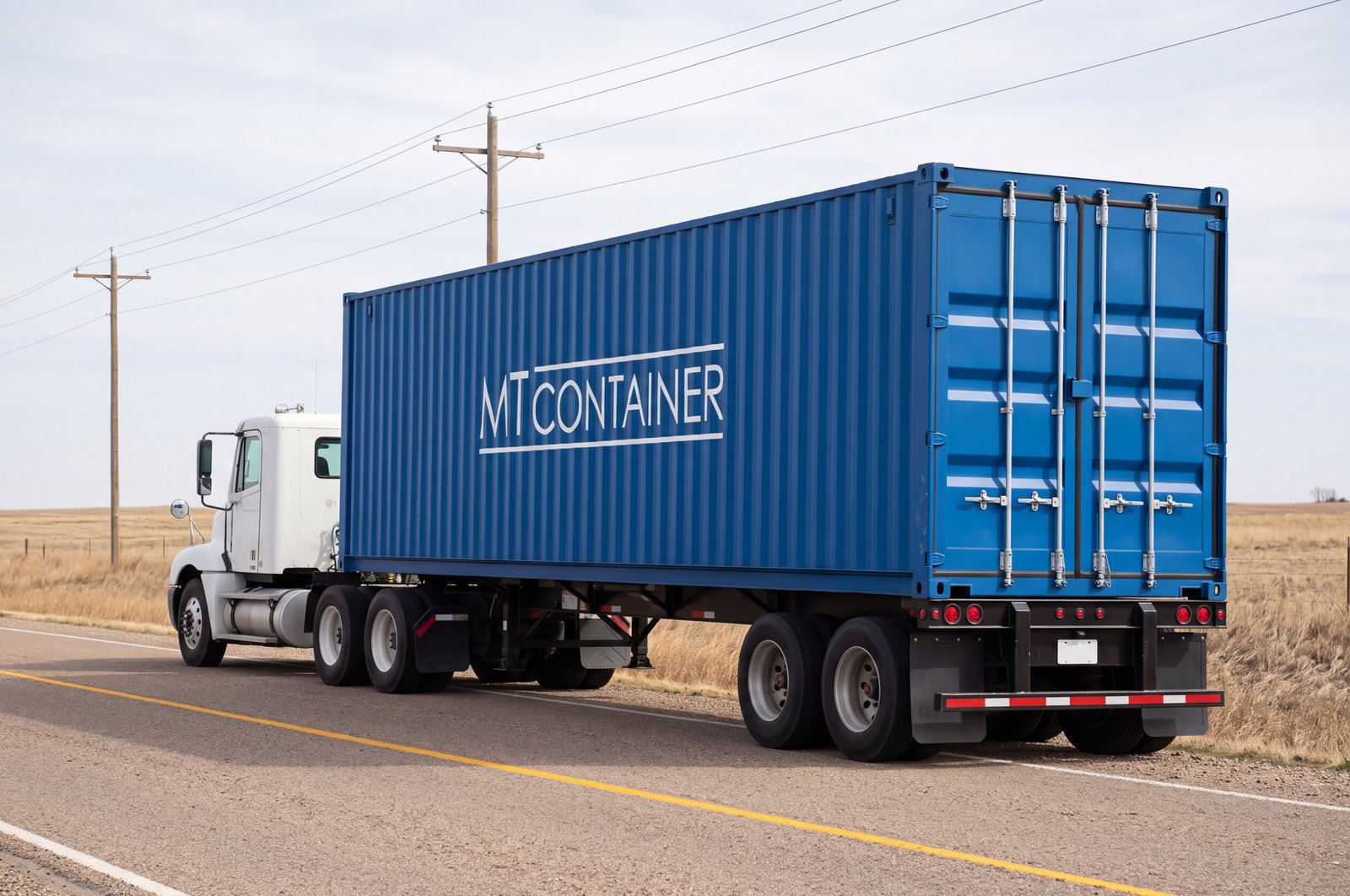
A container chassis is the wheeled trailer frame that carries a shipping container behind a truck tractor. An intermodal container chassis handles the road leg of a journey involving ports, rail terminals or a delivery site. The container holds the goods. The chassis supplies the frame, the wheels, the axles and suspension, the support legs, the locking devices, the brakes and the lights.
Choose the chassis to match the container, its loaded weight and the route. A standard chassis carries the box; placing it on the ground requires a separate unloading arrangement. If you are buying a storage container, that distinction belongs in the delivery agreement.
Container Chassis Types at a Glance
Length, frame shape and axle layout are separate features, so a chassis can be both a gooseneck and a tri-axle. The size labels below identify container classes, not the trailer’s exact overall length.
| Type | Configuration | Check |
|---|---|---|
| 20 ft | Chassis for a 20 ft container, such as a 23.5 ft slider | Loaded weight and approved axle position |
| 40 ft | Chassis for a 40 ft container, including gooseneck designs | Container tunnel and chassis compatibility |
| 45 ft | Dedicated 45 ft or approved 40/45 ft extendable chassis | Correct extension and locking positions |
| 53 ft | Domestic chassis for a 53 ft container used in North American inland transport | The specific domestic container and chassis pairing |
Frame shape and axle layout are chosen in addition to the size class:
| Type | Configuration | Check |
|---|---|---|
| Gooseneck | Raised front frame that fits a recess beneath a compatible container | Tunnel fit and total traveling height |
| Slider | Movable axle assembly or an adjustable chassis design | What moves and which positions the model permits |
| Tri-axle | Three chassis axles for suitable heavy-load applications | Axle loads, spacing and route limits |
The size pairings follow DCLI’s equipment overview; gooseneck and tri-axle designs are also described by CIE Manufacturing.
Gooseneck, Slider and Extendable: What Changes?
A gooseneck fits into the tunnel on the container’s underside. Hapag-Lloyd’s container specification, for example, confirms this tunnel on its 40 ft containers. Confirm the actual loaded height with the carrier, especially for a high cube, meaning a taller container.
A sliding suspension, also called a sliding bogie, is a movable wheel-and-suspension assembly. Moving it redistributes the cargo weight on the trailer axles. An extendable frame, by contrast, changes the length of the chassis itself, for example to carry either a 40 ft or a 45 ft container. Ask which of these mechanisms the word “slider” describes. Cheetah’s care and maintenance manual (2014, PDF), section 3, explains the sliding suspension and its locking pins.
Container Chassis Dimensions and Weight
TRAC’s published examples show the difference between size class and actual dimensions: its 20 ft slider is 23 ft 6 in (7.16 m) long overall, and its 40 ft gooseneck is 40 ft 8 in (12.40 m). Each has a listed tare weight, meaning the weight of the empty chassis, of 6,700 lb (about 3,040 kg). These are model examples, not universal specifications.
The FHWA guidance gives general Interstate limits of 80,000 lb (about 36,290 kg) gross, 20,000 lb (about 9,070 kg) per single axle and 34,000 lb (about 15,420 kg) per tandem axle group. Gross includes tractor, chassis, container and cargo. Exceptions apply. The Bridge Formula, a weight limit based on axle count and spacing, may restrict the combination further. A tri-axle alone does not authorize more weight; have the carrier check the actual weights and route.
How Twistlocks Secure the Container
A container chassis twistlock (also written twist lock) engages a lower corner casting, the reinforced fitting at a container corner. The locking head turns inside the fitting. Some chassis use other locking devices at particular positions, such as push-pin locks, which are cylinder-shaped; follow the equipment’s instructions. BNSF shows both in its Intermodal Hub Operations Manual (2011, large PDF), section E-4.4.
Under 49 CFR 393.126, all lower corners must be secured against unintended release, with the front and rear secured independently. The cargo inside the box also needs appropriate securement. The driver checks the locking equipment before road travel.
Who Supplies, Checks and Returns the Chassis?
In US intermodal transport, an equipment provider typically hands the chassis over to a trucking company; FMCSA calls this interchange. The driver checks it before road use. Where it goes back is set in the booking, so agree on who supplies the chassis, who arranges the carrier and where the equipment is returned. Put the pickup, unloading, waiting time and return arrangements in the transport order. Treat the list below as a booking checklist; the actual responsibilities and charges belong in the agreement.
- Equipment provider: FMCSA requires systematic inspection, maintenance and repair of intermodal equipment handed over to trucking companies. Reported defects must be addressed through the provider’s repair or replacement process before departure.
- Driver and trucking company: the driver checks the relevant components before road use, including visible brake parts, tires, lights, coupling equipment, support frames, container supports, locking devices and slider locks, and reports any defects.
- Buyer or receiving site: send the destination, access photos and placement requirements; obtain a written unloading plan and prepare the agreed area.
See FMCSA’s provider requirements and driver inspection guidance.
Chassis vs. Tilt-Bed Delivery
A tilt-bed truck hydraulically tilts its bed toward the ground so the container slides onto the placement area. A standard container chassis has no lifting gear of its own. Separate lifting equipment must place the container on the ground. That makes the unloading method a key question when you buy a container for stationary storage.
An example from our European business: on a construction site in Hamburg, one 10 ft and three 20 ft containers were set up in 2024 as lockable storage for tools and materials. Containers used this way stand on the ground, so the unloading method has to be settled before the truck arrives.
Eveon’s delivery explanation illustrates tilt-bed unloading and the need for firm ground, overhead clearance and clear space beyond the placement position. Send the carrier photos of gates, turns, the driveway, overhead obstacles and the final position. Ask for the clearances required by the assigned truck and unloading method.
Arrange a Container for Your US Site
MT Container has been trading containers from Hamburg, Germany, since 2008. New and used standard containers are sourced through our US partner network, subject to availability. Quotes are in USD, and our team responds in English.
MT supplies containers; chassis sales and chassis rental are not part of our offer. In the US, you can pick up the container or have it delivered by container truck. If you pick it up, your trucking company needs a chassis or truck that fits the container size. The unloading method depends on your site and is settled for each order. Send your ZIP code, container size, intended use and access photos with your container inquiry.
Questions About Container Chassis
What is a container chassis vehicle?
It is another name for a container chassis: a wheeled frame with locking points at the corners that carries a container on the road. In this guide, the chassis is the trailer pulled by a truck tractor.
How do container chassis work?
The container sits on the chassis frame. Twistlocks or other locking devices hold its four lower corners. The chassis supplies the wheels, brakes and lights, and a truck tractor pulls the combination. Lifting equipment places the container on the chassis. The driver checks the equipment before road travel.
How much does a container chassis weigh?
TRAC lists 6,700 lb (about 3,040 kg) for its 20 ft slider and 40 ft gooseneck examples. That weight counts toward the gross weight of the truck combination. For transport planning, obtain the tare weight of the actual model.
Can a container chassis unload itself?
No. A standard container chassis needs separate lifting equipment to set the container on the ground. A tilt-bed truck works differently: it tilts its bed so the container slides to the ground. Confirm which unloading method is booked.
Sources and Scope
Sources checked November 26, 2026. The linked technical references describe equipment and US road responsibilities. Metric equivalents are calculated from the cited US values and rounded. Diagrams explain the concepts and are not drawn to a measurement scale. The booking checklists are our editorial recommendations.